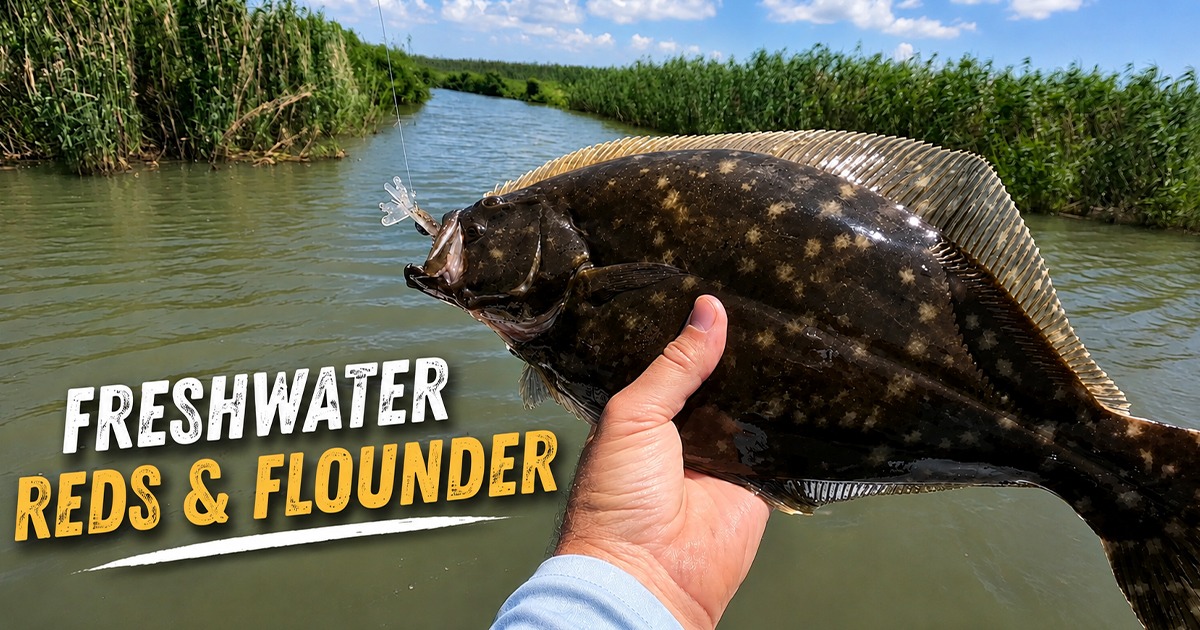
Redfish and flounder in 100% freshwater?
Yep.

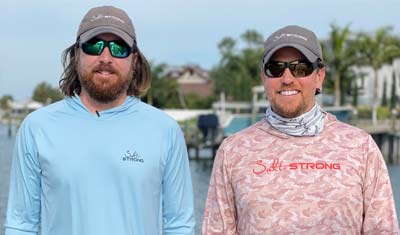
Luke and I just got back from one of the wildest fishing trips we’ve taken in a long time, and there were moments when you genuinely had no clue what was going to eat your lure next.
A largemouth bass?
A flounder?
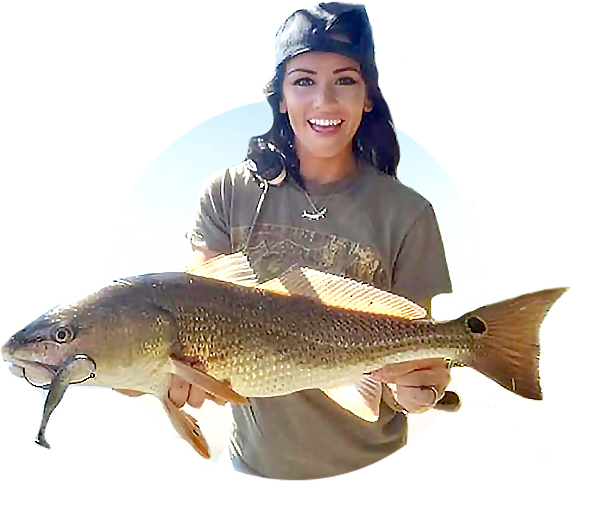
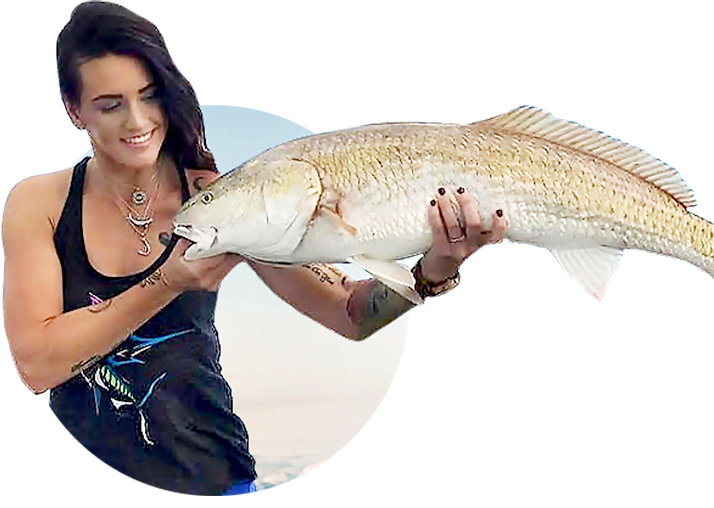
A big redfish?
All of them were swimming in the SAME water.
But the craziest part wasn’t just what we caught.
It was how ridiculously repeatable the pattern became once we figured out the one type of spot these fish kept stacking around.
And this wasn’t some Louisiana-only trick.
If you fish coastal rivers, marshes, creeks, or backwaters anywhere from Texas to the Carolinas, you’re going to want to see this.

Limited time: Salt Strong Insiders can save 50% off MSRP on the Slam Stick Traveler featured in this podcast, plus score BIG savings on the Slot Machine, Slam Stick, combos, bundles, and more while the deals last. This offer ends September 8th, 2026, so don’t wait!
Featured Gear
- Lure: Prawn XT Jr.
- Rigging: 3/0 Hoss Weedless Football Jighead 1/4 oz
- Rod: Slam Stick Traveler
- Reel: Otis 2500 (3000 Coming Soon)
- Line: 10 lb J-braid
- Leader: Ande 30 lb mono leader
The Prawn XT Jr. was the star of the trip. Luke fished the same soft plastic for all three days and landed at least 60 fish on it, while most of the fish we caught overall came from bouncing that shrimp imitation along the bottom.
Yes, Redfish And Flounder Can Live In Freshwater
This trip was in the Venice, Louisiana area, but we weren’t fishing what most anglers would think of as traditional saltwater.
We literally dipped our fingers into the water and tasted it.
No salt.
Yet we were catching redfish, black drum, flounder, and other saltwater species right alongside freshwater species like largemouth bass and gar.
That alone made the trip pretty surreal.
But more importantly, it showed just how far certain inshore species can push into coastal freshwater systems when the habitat and food are right.
And these weren’t random fish.
We caught more redfish, drum, and especially flounder than we had on any of our previous Louisiana trips.
Luke estimated we caught at least 30 flounder during the first two days alone.
Find Creek Intersections And Fish The Bottom
This was the biggest lesson from the entire trip.
We kept targeting places where a smaller creek met another creek, river, canal, or larger body of water.
These intersections create natural funnels.
And around the mouth of those smaller creeks, there’s often a depression or drop caused by moving water.
That little depth change is PERFECT for ambush predators.
Flounder can sit right on the bottom.
Redfish and black drum can patrol the edges.
And bait gets pushed right through the strike zone.
Our approach was incredibly simple:
Fish one point of the creek mouth.
Fish the other point.
Fish through the middle.
Then work a little farther down either side.
It was rare for us to fish one of these intersections without getting at least one bite, and some held multiple redfish or flounder.
The other thing we watched for was bait and birds.
If we saw mullet working a shoreline or multiple egrets hanging around a creek mouth, that spot immediately moved up the list.
Those clues helped us find the most productive intersections much faster.
Why Bouncing A Shrimp On Bottom Crushed The Fish
Popping corks are extremely popular in Louisiana.
And they absolutely catch fish.
But for what we were targeting, getting the lure all the way to the bottom was the difference maker.
The flounder were sitting down in those depressions near the creek mouths.
Black drum often had their heads down feeding.
And many of the redfish were eating close to the bottom too.
We watched other anglers fish similar areas with popping corks, then came through afterward and caught flounder they had completely missed.
Our primary presentation was a Prawn XT Jr. on a 1/4 oz jighead, bouncing along the bottom through those deeper zones.
We also made sure we had enough weight to maintain bottom contact whenever the current picked up.
And surprisingly, the water was extremely murky, but we didn’t need crazy colors, excessive noise, or complicated presentations.
Put a natural-looking shrimp in the right zone and keep it near the bottom.
The fish handled the rest.
Final Thoughts
Freshwater redfish and flounder sound strange until you see it happen.
But the biggest takeaway from this trip wasn’t Louisiana, freshwater, or even the ridiculous number of fish we caught.
It was how transferable the pattern was.
Find a creek or drain entering a larger body of water.
Look for the points and deeper depression around that intersection.
Confirm there’s bait or bird activity nearby.
Then put your lure on the bottom and work the entire zone.
Luke uses the same basic strategy in Florida, Texas, and other marsh systems, and it worked almost immediately for us in Louisiana too.
Have you ever caught a redfish, flounder, or another saltwater species WAY farther into freshwater than you expected?
Let me know in the comments!
Freshwater Redfish & Flounder FAQs
Can redfish live in freshwater?
Yes. Redfish can move into freshwater portions of coastal rivers, creeks, and marsh systems. On this trip, we were catching redfish in water where we couldn’t taste any salt at all.
Can flounder live in freshwater?
Flounder can also move well into low-salinity and freshwater coastal systems. We caught roughly 30 flounder during the first two days of this trip while fishing freshwater creek systems.
Where should you look for redfish and flounder in coastal creeks?
Focus on creek intersections, especially where a smaller creek or drain enters a larger creek, river, or bay. These spots often have deeper depressions near the mouth that attract feeding fish.
What lure worked best?
The Prawn XT Jr. on a 3/0 Hoss Weedless Football Jighead 1/4 oz caught the vast majority of the fish. We worked it slowly along the bottom through creek mouths, points, and deeper holes.
Do you need a popping cork?
No. In fact, bouncing the lure directly along the bottom was much more productive for the flounder and bottom-feeding fish we were targeting on this trip.
Does incoming or outgoing current matter?
We caught fish during both incoming and outgoing flow. Luke’s takeaway was that being in the right creek intersection and keeping the lure near the bottom mattered more than obsessing over current direction.



please make a 2/0 weedless jig head,
When I pin the weight, I feel like the hook is too far back on the tail. You mentioned coming out with a smaller shrimp…the 2/0 would be perfect
If you fish weedless do have to set the hook in the side or strait up
WE HERE IN SAN ANTONIO HAVE BEEN FISHING AND CATCHING LARGE REFISH FROM 2 OF OUR CITY PUBLIC LAKES ON THE OUTSKIRTS OF OUR CITY FOR ABOUT 50 YEARS NOW! WE CAN CATCH ON LIVE BAIT OR MANY COMBINATIONS OF BAITS- THE BEST WAY TO CATCH THEM IS TO USE DOWNRIGGERS AND A “PET SPOON”. BOTH OF THE LAKES ARE WITHIN APPROX. 5 MILES FROM THE OTHER ONE! THE NAMES OF THE BIGGER LAKE IS LAKE CALAVERAS OFF HWY. 181 SOUTH! THE OTHER IS LAKE BRAUNIG ON US 37S ON THE WAY TO THE TEXAS COAST! AT ONE TIME IN THE PAST WE HAVE A FISH CALLED THE CORVINA WHICH WAS A CROS BETWEEN THE BAY OF CORVINA AND A TEXAS SPECK! THE OTHER EXOTIC WAS A PERCH CALLED THE NILE PERCH- IT COULD GROW TO OVER 100 POUNDS- THE ALSO HAD SOME TARPON IN CALAVERAS WHICH HAS DIED OFF SHORTLY AFTR LAKE OPENED TO THE PUBLIC! AND YES WE DID HAVE THE TILAPIA IN BOTH LAKE AND THEY ARE STILL IN THEM! – BOTH LAKES HAVE RV SET-UPS AND SEVERAL NICE BOAT LAUNCHES ! I DON’T KNOW IF THEY STILL ALLOW OVERNIGHT CAMPING AND PIER FISHING! BOTH LAKES WERE SAN ANTONIO’S ONLY GENERATING PLANT FOR THE ENTIRE CITY AND BEXAR COUNTY AND MIGHT STILL BE!
AT ONE TIME I WAS A EVERYDAY OR SO FISHERMAN- I FORGOT TO MENTION THAT WE HAVE BIG BLACK BASS IN THE LAKE -ALSO WE HAVE PERCH BUT NO CRAPPIE ANYMORE AT EITHER LAKE FOR THE LAST 30 OR SO YEARS! THEY HAVE CATFISH AND FISH LIKE THAT OVER THE ENTIRE LAKE!
IF YOU ARE A DIVER – THERE IS A DRAG BOAT ON LAKE CALAVERAS ALMOST STRAIGHT FROM THE DAMN ON THE BOTTOM – IT WAS AN ALCOHOL BLOWN BOAT OWNED BY A MAN THAT WAS KILLED IN IT BY THE NAME OF RONNIE THOMAS A PERSONAL FRIEND- ANYTHING RONNIE WAS A PART OF WAS OF THE BEST EQUIPMENT MONEY COULD BY BACK THEN- ITS BEEN ON THE BOTTOM OUT THERE FOR MORE THAN 50 YEARS! THE ENGINE WAS A 454+. IT HAD A BLOW OVER AND HE WAS KILLED! I NEVER SAW ANOTHER DRAG BOAT ON THE LAKE AGAIN!
JUST A LITTLE INFOR ON THE REDFISH IN BRAUNIG AND CALAVERAS LAKES ON THE OUTSKIRTS OF SAN ANTONIO TEXAS! THE GET BIG QUICK WITH ALL THE BAIT FISH IN THE LAKE! BUT THEY DON’T BREED IN THE LAKE LIKE THE REST DO! IF YOU COME TO FISH AND WANT A GREAT LITTLE SEAFOOD LATE TAKE A TRIP TO ‘LAGUNA MADRE” IN SA- I THINK THEY HAVE ABOUT 4 LOCATIONS! THERE IS ONE JUST MILES NORTH ON HWY 37 OR HWY 281 NORTH A SOUTHCROSS STREET- THEY HAVE SOME GOOD GRUB THAT FISHERMAN LOVE!
Red fish can absolutely survive in fresh water when I Lived in Dallas Texas the Texas parks and wildlife had several lakes south of Dallas stacked with red fish. One of them was lake Fairfield off interstate 45.
San Antonio has a lake near by called Calaveras Lake and there’s ALWAYS redfish fish being caught there.
On my first trip to Venice many years ago we anchored in Main Pass at the mouth of a creek. We caught 12 different species of salt and freshwater fish on the same plastic grub in that spot and caught a limit on several species. It hooked me on Venice!
One of the largest redfish and black drum I have seen caught in Crystal River was in Kings Bay at the head of the river.
The drum was just short of the State record.
One of the best places to catch snook in my area is the lock at the east end of the C54 canal where it meets the north branch of the Sebastian River. Just make sure that you have both a fresh water fishing license and salt water fishing license as well as a Snook stamp. Tight lines y’all!
Great posting guys. Thanks for sharing this trip. What a wild fishery
Here in Charleston we also find trout and flounder way up the Cooper and Ashley Rivers in the tidal creeks.
Curious, did you guys “check baggage” the rod cases or carry on? The tube length seems to be the factor.