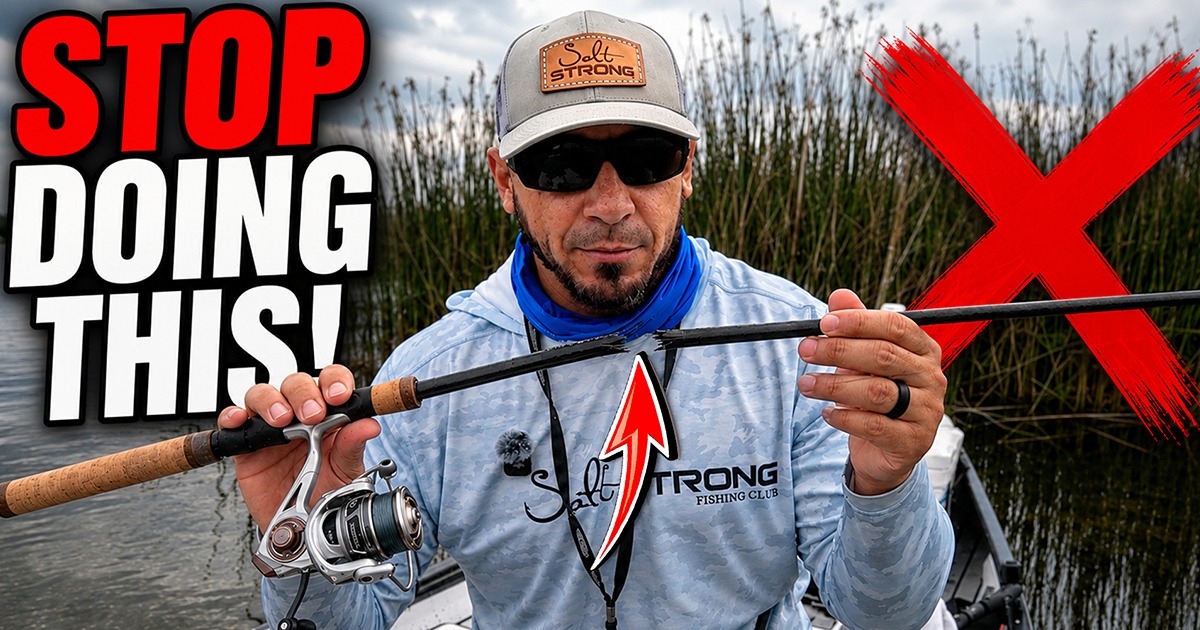
Premium fishing rods are incredible tools.
They’re lighter, more sensitive, and can help you detect strikes, structure, and bottom composition that many anglers would otherwise miss.
But that performance comes with a tradeoff…
Many anglers accidentally damage these rods long before they ever break.
So I wanted to share some simple rod care tips that can help your gear last longer and perform at its best.

Featured Gear
- Rod: Slot Machine
Why Do High Performance Fishing Rods Break?
Most premium fishing rods are built with lightweight graphite blanks designed for maximum sensitivity and performance.
That sensitivity allows anglers to feel grass, oysters, bottom transitions, and subtle bites more easily.
However, graphite blanks can be damaged by impacts that may seem insignificant at the time.
A jighead striking the blank, rods bouncing together during transport, or repeated impacts in a truck bed can weaken the blank and eventually lead to failure.
How Should You Transport Fishing Rods?
One of the easiest ways to extend the life of a fishing rod is to protect it during transport.
A few best practices include:
- Use rod sleeves whenever possible.
- Secure rods together with Velcro straps.
- Prevent rods from bouncing around in the truck bed.
- Avoid allowing lures or jigheads to strike the rod blank.
Many rod failures actually begin long before the fish is hooked.
Should You Rinse Fishing Rods After Saltwater Trips?
Yes.
After every saltwater trip, rinse rods thoroughly with fresh water.
Pay special attention to:
- Guides
- Reel seats
- Handle components
After rinsing, dry the rod with a clean towel and allow it to finish drying horizontally whenever possible.
Storing rods horizontally helps prevent water from collecting around guide feet, which can eventually lead to corrosion.
How Do You Clean Cork Fishing Rod Handles?
Cork handles naturally collect dirt, fish slime, sunscreen, and other contaminants over time.
A simple Magic Eraser can help restore cork handles and keep them looking clean.
After cleaning, many anglers choose to apply a cork sealer for additional protection and longevity.
Why Should You Clean Rod Guides?
Braided fishing line can leave residue and color buildup on rod guides.
Over time, dirt, debris, and braid residue can create friction that affects casting performance.
A simple wipe-down of the guide inserts with a clean cloth helps keep line moving smoothly through the guides.
What Is High-Sticking?
High-sticking occurs when an angler lifts the rod too high while fighting a fish or pulling against a snag.
This places excessive pressure on a small section of the blank and can lead to breakage.
To reduce the risk:
- Avoid lifting the rod past roughly 45 degrees while fighting fish.
- Point the rod directly at snags when attempting to free a lure.
- Let the rod’s power work for you instead of forcing the blank into extreme angles.
Final Thoughts
High performance fishing rods are designed to maximize sensitivity, casting performance, and fish-fighting capability.
A little care goes a long way.
Protecting the blank from impacts, transporting rods properly, cleaning them regularly, and avoiding high-sticking can help ensure your rod performs the way it was designed to for years to come.




I bought rod sleeves from Salt Strong, there the best I have found.
Solid choice!
I use rod sleeves now that I have good rods. Great info Tony!
Thanks Jay!
Some great info for taking care of our rods. Thanks.
You’re welcome Troy!
Tony, thanks for sharing. The tip about the Mr. Clean eraser for the cork handle was amazing. My TFO Pro cork was looking FUGLY AS HELL and now it looks brand new. Thanks again for that little gem of info!! Matt
You’re welcome Matt!
Great and valuable information on rod protection. Thank you!
You’re welcome David!
All good tips. It will also increase the useful life of your rod to minimize its exposure to UV light. I have seen anglers who store their rods, reels, and line on racks attached to the outer walls of a shed, or to their truck or boat. Sunlight will degrade not only the non-metallic components of the rod, but plastic parts of the reel, as well as the line itself. Tackle spends most of its “life” in temporary storage, so the UV exposure during use and transport is comparatively insignificant.
For sure! Salt+sun can speed up that process as well
I found if you go to a flooring company (carpet or laminate insulation) they have pressed cardboard tubes that material comes on ⅜ x3 in diameter 12 foot long just ask they throw them away anyways .They are perfect for rod transport sometimes big enough for bait caster and rod together just put a cap of some sort on the end I found peanut butter lids work perfect. Anyways thought I’d share that idea
Good info!
Thank You….Nice and simple.
You’re welcome Bill!
Great tips!! Thanks for sharing.
You’re welcome Justin!
To me that is a simple problem solved easily how you ask? Simple USE YOUR COMMON SENCE!!! And ALWAYS take care of it don’t do what i see frequently where I live where alot of rednecks don’t think and that’s throw your combo in the back of your dirty pickup where it can get knocked around and dirty and scratched in otherwords take care of it and it will to you in return basically you get out of it in what you put into it if you abuse it like anything else it will fail you miserably ALL my rods are at least 10 years old and look like and perform like new because I take care of them they are an investment in my sport and I hate spending money on something I don’t need or want if I already have something that works great already thanks for your input and all you do 🤔😉👍
Just like you said, a lot of people don’t think and it helps to have a reminder! Some people also just don’t know, especially with expensive rods. Just because they’re expensive, doesn’t mean they indestructible.
Absolutely exspensive doesn’t mean they won’t break it just means that if used properly AND taken care of that a premium quality rod will last longer because the high quality components that the rods are made with ex: the blanks, rodline guides, reelseats thanks for the reply back😉