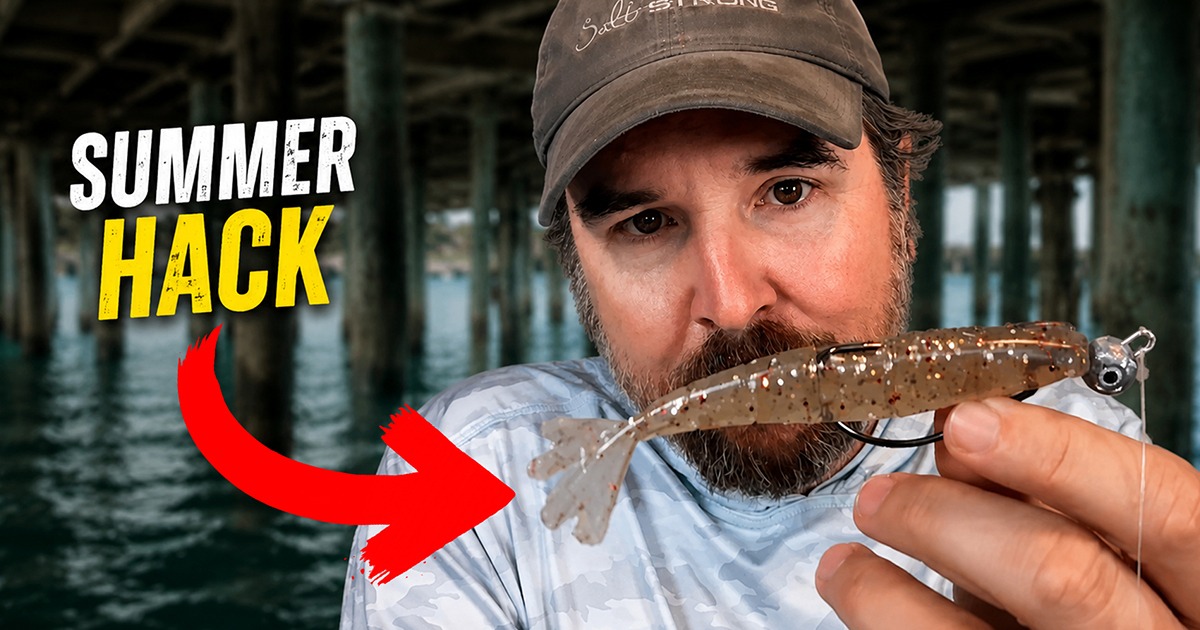
Summer can be one of the best times of year to catch quality fish around structure.
As water temperatures rise, redfish, snook, trout, and flounder often become more predictable in where they position themselves.

And if you’re willing to make one simple adjustment to your rigging, you’ll be able to put your lure right where they’re holding.
Watch below to find out where fish tend to hold during the summer and the rigging setup that’s helping catch them.

Insiders, if you want to give this rigging a shot for yourself, June’s Tackle Tester is the Hoss Weedless Round Eye Jighead. Claim yours here.
Featured Gear:
- Rigging 1: Hoss Weedless Round Eye Jighead
- Rigging 2: Hoss Football Jighead
- Lure 1: Prawn USA Original
- Lure 2: Prawn USA Junior
Featured Software:
Why Summer Fish Hold Tighter To Structure
One of the biggest changes that happens during the summer is a decrease in dissolved oxygen levels.
As water temperatures climb, fish naturally become less active and often seek out deeper water where conditions are more comfortable.
That means many fish aren’t roaming expansive flats like they might during other times of the year. Instead, they’re positioning around:
- Docks
- Bridge pilings
- Oyster bars
- Rock piles
- Reefs
- Grass edges
These areas provide shade, current breaks, ambush opportunities, and easy access to food.
If you want to consistently catch fish during the warmer months, focusing on structure becomes increasingly important.
The Biggest Summer Fishing Mistake
Many anglers continue fishing the same way they did during the spring.
They make long casts across open water, retrieve too quickly, and spend very little time near the bottom.
The problem is that most feeding activity during the summer happens close to structure and close to the bottom.
Another common mistake is using exposed-hook jigheads around heavy cover.
While exposed hooks can offer excellent hookup ratios, they also snag constantly around docks, rocks, oysters, and other underwater obstacles.
That often leads to anglers spending more time re-rigging than actually fishing.
The Weedless Rigging Setup That’s Working
The biggest game changer discussed in this lesson is weedless rigging.
Instead of worrying about snagging every dock piling or oyster clump, a weedless setup allows you to fish directly in the areas where fish are most likely to be holding.
That means you can confidently work:
- Dock pilings
- Rock piles
- Jetties
- Oyster bars
- Nearshore reefs
- Grass edges
The benefit isn’t necessarily that weedless rigs catch more fish on their own.
The benefit is that they allow you to put your lure where the fish actually are.
And when fish are positioned tight to structure, that makes a huge difference.
Choosing The Right Jighead Weight
One of the most overlooked parts of summer fishing is depth control.
If your lure isn’t reaching the strike zone, the rest of your presentation doesn’t matter.
For most dock fishing situations, a quarter-ounce jighead is a great starting point.
It provides enough weight to reach bottom in deeper water while still remaining light enough to skip effectively beneath docks.
As depth increases, heavier jigheads may become necessary.
The key is finding the lightest weight that still allows you to maintain contact with the bottom.
Many anglers spend a lot of time debating jighead shapes, but getting the correct weight is usually far more important than whether you’re using a round head or football-style head.
Click here to see the Rigging Guide
How To Fish Docks In The Summer
Dock fishing can be incredibly productive during the warmer months.
When selecting docks, look for areas with:
- Good current flow
- Nearby deep water
- Natural shorelines
- Access to passes or inlets
Docks near moving water often hold more bait and provide a steady food source for predator fish.
Natural shorelines tend to outperform seawalls because they create a more natural environment for baitfish, shrimp, and crabs.
Older docks can also be especially productive.
Barnacle-covered pilings, algae growth, and years of marine life accumulation create an entire ecosystem that attracts bait and gamefish alike.
Once you arrive at a dock, focus on getting your lure deep into the shade and close to the pilings.
That’s where fish feel most secure.
A weedless setup makes it possible to fish these high-percentage areas without constantly getting hung up.
Why Shrimp Profiles Shine In Summer
While paddletails and jerk shads remain excellent options, shrimp profiles can be particularly effective during the summer.
Shrimp are a natural food source throughout the year and become an easy target when fish aren’t feeling especially aggressive.
A shrimp imitation allows anglers to slow down their presentation while still maintaining a natural look.
That combination can be deadly around structure.
Another benefit is versatility.
A properly rigged shrimp lure can catch just about everything that swims inshore, including:
- Redfish
- Snook
- Speckled trout
- Flounder
- Cobia
- Tripletail
- Grouper
- Mangrove snapper
When conditions get tough, shrimp profiles often continue producing bites.
Don’t Camp On One Dock
One of the most valuable lessons from this discussion has nothing to do with tackle.
It’s about efficiency.
Many anglers spend far too much time fishing unproductive water.
Instead of making dozens of casts around the same dock, make a few quality presentations and move on.
In many cases, the first cast produces the strike.
If a fish is positioned beneath a dock and your lure lands in the right spot, you’ll usually know pretty quickly.
Covering water allows you to locate the small percentage of docks holding the majority of the fish.
Keep moving until you find them.
Final Thoughts
Summer fishing doesn’t have to be difficult.
When fish move deeper and tighter to structure, success often comes down to putting your lure where other anglers can’t.
A properly rigged weedless setup allows you to fish docks, rocks, oysters, reefs, and other high-percentage areas with confidence while spending less time dealing with snags and more time fighting fish.
Master that simple adjustment, and you’ll put yourself in position to catch more fish all summer long.



Do you cast up or down current?
For lures, it’s best to cast up current so that the retrieve is pulling the lure with the current flow.
But the proper positioning needs to also factor in the wind too. Details on how to balance the two factors are explained in the Positioning lessons in the Fishing School: https://www.saltstrong.com/fishing-school/
Nice and concise…good info!
Can we expect a baitcasting Slot Machine soon?
That is in the works, but no telling on how long it’ll take to pass through out testing because it all depends on how many adjustments we need to make until it’s provably better than what’s currently out on the market.
Question, if you push the lure all the way up to the head and don’t let the head swivel, why don’t you just use a regular hook without the swiveling head? Just curious. Thanks Deric
Two reasons: 1) the pivoting head is better at not getting dislodged as the fish is fighting relative to a longer fixed hook design, and 2) the full hook style jigheads don’t have as much gap from the head to the turn of the hook, so the pivoting head design allows for more fish caught per lure
Hey everybody this is Joe Simon’s “Like Diamonds and this is “LUKE SIMONS”
………………………………………………
And JOE says ……..”LIKE DIAMONDS”
🤣🤣🤣🤣🤣🤣🤣cracks me up every single time 🤣🤣🤣🤣🤣🎣🎣🎣🎣🎣🎣🎣🎣🎣🎣🎣🎣🎣🎣
Haha
Slam stick in bait casting please
Thanks for showing interest in a baitcast version of the Slam Stick. That is on the agenda, but it’ll likely be mid 2027 at the earliest because it takes a lot of time to get through testing before we take anything new live.
Always great info Luke, thanks.🤗🎣🙏💯
Thanks Bob!
Thanks for everything you guys made big difference to the way I am fishing today whit really good results
Our pleasure! Thanks so much for making time to post the nice comment.
Thanks for the pointers guys can’t wait to use this product. I’ll be heading down to Anna Maria Island around the end of June out fishing is great there thanks again guys
Our pleasure! I hope your upcoming trip is a blast.
Thanks for reminding us of some simple techniques to hook up.
Our pleasure Troy!