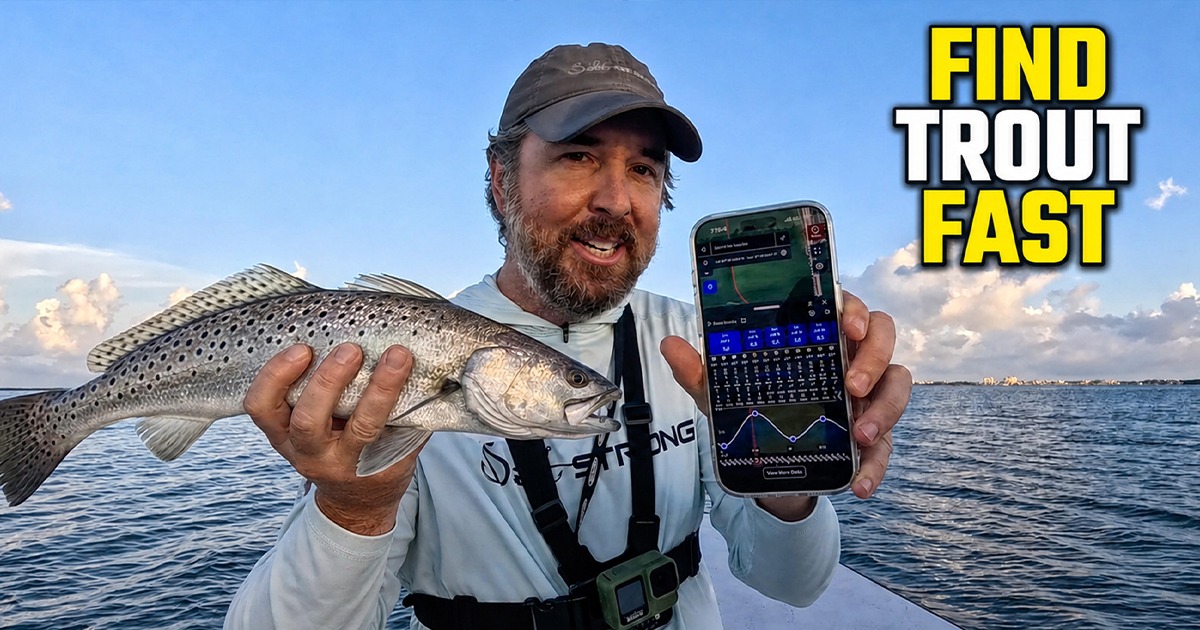
If I want to catch a bunch of seatrout in a saltwater bay, this is the strategy I trust most, even when the tide is weak.
You don’t need a trolling motor, expensive marine electronics, or live bait.

All you need is something that floats, a couple lures, and a plan for setting up productive drifts.
In this case study, I’ll show you exactly how to:
- Choose high-percentage summertime seatrout spots
- Use your phone as a powerful fishing GPS
- Plan and repeat productive drifts
- Catch fish during a tough slack-tide window
I also put my two favorite seatrout lures head-to-head. One of them was the clear winner for both the quality and quantity of strikes.

Featured Software:
Featured Gear:
- Rod: Slot Machine 7’6″ Medium
- Reel: Otis 2500
- Line: 8 lb Daiwa J-Braid 8 Grand
- Leader: 20 lb Ande Mono
- Lure 1: Skinny Lipper – Slam Shady
- Lure 2: The 2.0 – Slam Shady rigged on 3/0 Hoss Weedless Round Eye 1/4oz
Other:
- Boat: 22′ Micro Draft
- Sunglasses: Smith – Guide’s Choice
- Pliers: Danco Pro Series
Where To Find Seatrout In Saltwater Bays
The most important part of catching seatrout is finding the right zone.
For this trip, I focused on grass flats located next to deeper water, channels, bridges, and other areas with current flow. I also looked for signs of life, including baitfish and diving birds.
The key wasn’t simply finding a good-looking flat. It was identifying the specific depth where the trout were feeding.
During my first few drifts, most of the action came along the deeper edges of the grass. Once I recognized that pattern, I could stop wasting time in water that was too shallow or too deep.
That’s when the catch rate really started to improve.
How To Set Up Productive Drifts
A controlled drift lets you cover water without constantly running the trolling motor or making noise around the fish.
After completing a drift, I reviewed my track and marked where the strikes happened. I could then reposition the boat and make another drift through a slightly different section of the productive zone.
The goal isn’t to follow the exact same line repeatedly. Instead, use each drift to learn where the fish are holding and then adjust your next pass accordingly.
That process helps you quickly eliminate dead water and maximize the amount of time your lure spends in front of feeding fish.
How Smart Fishing Spots Helps You Find Fish Faster
One of the biggest challenges, especially in a new area, is deciding where to begin.
Smart Fishing Spots helps narrow the search by highlighting areas that match the conditions. Instead of randomly working miles of shoreline, you can focus on locations with the highest probability of holding fish.
The tracking feature is especially valuable when drift fishing. It shows exactly where the boat traveled, making it easy to compare productive and unproductive passes.
You can also use it to:
- Find high-percentage fishing zones
- Monitor your location and drift direction
- Safely navigate unfamiliar water
- Mark catches directly on your private map
- Return to productive areas on future trips
It essentially turns your phone into a powerful fishing GPS that you can use anywhere on the boat.
Hard Plug vs. Paddletail
For this trip, I alternated between two Slam Shady lures:
I started by making three casts with one lure and then switching to the other. That gave both lures repeated opportunities in the same water and under the same conditions.
The Skinny Lipper generated the most strikes early in the trip and produced some of the better trout. Its larger profile and erratic action appeared to trigger fish even when they weren’t feeding aggressively.
As the sun climbed higher, the paddletail began performing better. Its ability to stay deeper in the water column made it more effective once the fish settled lower.
The big lesson is that lure performance can change throughout the day. Test different profiles and depths instead of assuming one lure will always be the best choice.
Why Every Angler Should Keep A Catch Log
Every fishing trip teaches you something, but only if you remember the details.
Recording where you caught fish, along with the tide, wind, weather, season, and lure, helps reveal patterns that would otherwise be easy to miss.
The Smart Fishing Spots catch log makes this process simple. When you upload a photo from your phone, it can automatically associate the catch with its location, time, weather, and tide information.
Over time, you can filter your catches by factors such as:
- Month or season
- Tide cycle
- Current flow
- Wind direction and speed
- Air temperature
- Barometric pressure
- Moon phase
- Lure selection
That turns each trip into useful information you can apply the next time you’re on the water.
Eventually, your private catch log becomes one of the most valuable fishing tools you own.
Final Thoughts
You don’t need expensive equipment or a complicated boat setup to catch a bunch of seatrout.
The winning formula is simple:
- Find grass flats near deeper water and current.
- Look for bait, birds, and other signs of life.
- Use controlled drifts to cover water.
- Track where your strikes occur.
- Repeat your drifts through the most productive depth.
- Match your lure to the depth and activity level of the fish.
A tool like Smart Fishing Spots can dramatically shorten the learning curve by helping you find promising areas, structure your drifts, and save everything you learn.
That means less time searching—and more time catching fish.
Have you tried this style of drift fishing for seatrout? What lure produces the most strikes for you?
Let me know in the comments!



luke you need to mount a phone holder to that box before it ends up in the drink.
Luke. Great information. Is their a video of exactly how to setup the app to show the route and how to add the pics?
Thanks! I plan to put this method to the test next week!
Love it, Luke! Great stuff
Thanks for another great video Luke!
thanks
Very helpful hints, thank you!
This is good information. I recently had a very unproductive (and hot!!) kayak fish from a nice looking flat with a creek emptying into it. But as Luke pointed out, there wasn’t any particularly deep water or drop offs for the fish to cool down. Slack tides are tough.
What TRULY blows my mind is that I show my psycho fishing friends this app stuff and it blows their mind but yet they still won’t join up 🙁
Thanks Luke! The grass on the surface is insane this type of year.