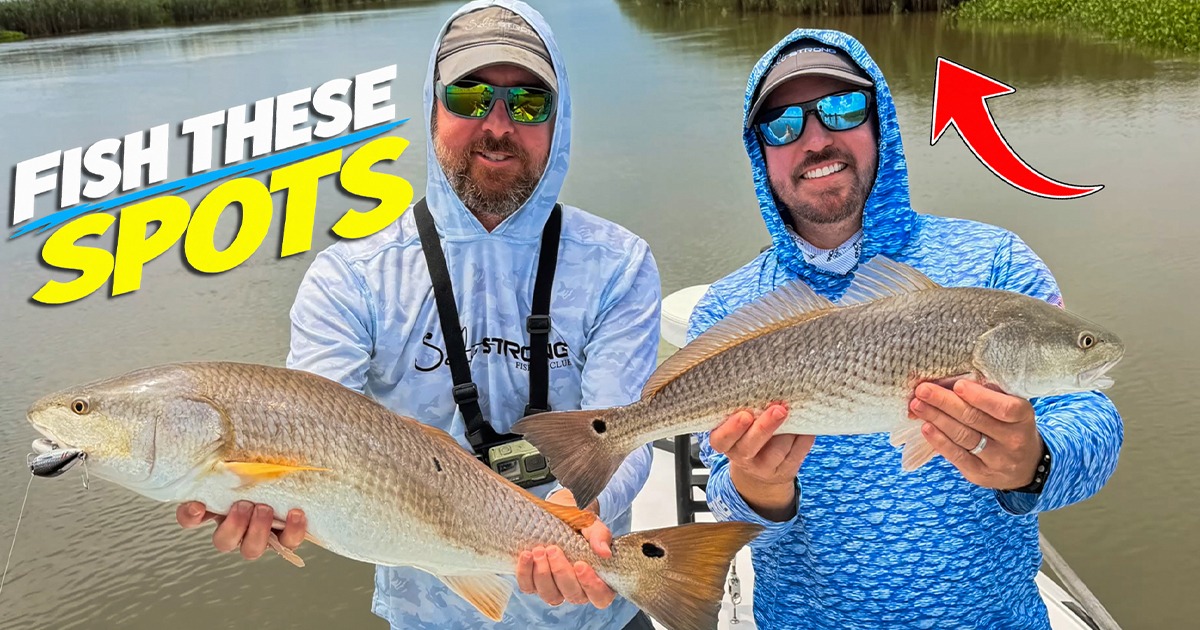
Saltwater marshes can be absolutely LOADED with redfish, flounder, and black drum.
But with miles of shoreline, countless creek mouths, and plenty of places for fish to hide, where the heck do you start?

On a three-day fishing trip to Louisiana, Joe and I discovered just how effective ONE simple marsh fishing strategy can be.
And the best part?
We caught a ridiculous number of fish without constantly changing lures, rigs, or techniques!
Here’s how we did it (and how you can use the same approach in your home waters).

Featured Gear
- Lure 1: Prawn XT Jr. (3.5″)
- Rigging 1: 3/0 Hoss Weedless Round Eye Jighead 1/4 oz
- Rod: Slam Stick Traveler (M-MH)
- Reel: Otis 3000 (Coming Soon) – Get the Otis 2500 here.
- Lure 2: Wake Mullet
1. Start With the Corners of Marsh Creek Mouths
Our original plan was to target bull redfish in bigger water around Venice, Louisiana.
Unfortunately, the fish didn’t get that memo.
So Captain Hollywood suggested we head into the marsh and start targeting the corners where smaller creeks meet larger waterways.
And that changed EVERYTHING!
Instead of randomly casting along miles of shoreline, we focused on these creek intersections.
The key areas were:
- The points and corners where smaller creeks entered larger waterways.
- The upcurrent shoreline leading into those intersections.
- Roughly 100 feet of shoreline on either side of the creek mouths.
These areas gave us smaller, more manageable zones to search rather than blindly covering water.
And it didn’t take long to start getting bites!
We caught redfish, flounder, and black drum using this same approach across multiple sections of the marsh.
One important lesson: Don’t overlook the really small creeks.
One of our most productive stops was a tiny creek that didn’t look like much from the outside. Yet it produced multiple redfish, including some really nice ones!
Sometimes the smallest openings can hold a surprising number of fish.
2. Let the Current Do Some of the Work
Finding the right location is only half the battle.
HOW you present your lure can make just as much of a difference.
Throughout most of this trip, I used a Prawn XT Jr. rigged on a 1/4 oz Hoss Weedless Round Eye Jighead.
My retrieve was incredibly simple:
- Cast upcurrent toward the structure or shoreline you’re targeting.
- Allow the shrimp lure to sink toward the bottom.
- Use slow twitches and hops to bounce the lure along the bottom.
- Maintain contact with your lure and pay attention for those subtle thumps!
That was pretty much it!
We were often fishing unfamiliar bottom structure, including areas where I could feel what seemed like rocks or shell.
The weedless jighead allowed me to work those areas with less risk of getting snagged.
And here’s an important detail…
You don’t have to use the exact same retrieve speed in every depth.
In deeper water, I could let the lure sink and bounce it along the bottom.
When we moved into shallower sections, I sped up the retrieve slightly to keep the lure from constantly dragging bottom.
The goal was to keep the shrimp moving naturally through the strike zone.
This simple adjustment helped us catch fish in water ranging from very shallow sight-fishing areas to deeper marsh channels.
3. Don’t Ignore the Shorelines BETWEEN Creek Mouths
Creek intersections were our primary targets, but they weren’t the only places we found fish.
As we worked from one creek mouth to the next, we continued casting along the shoreline.
And that produced some excellent action, too!
One particularly productive approach was casting tight against the reeds, letting the lure reach bottom, and slowly twitching it away from the shoreline.
We also paid close attention to signs of fish activity.
On day two, we noticed large wakes moving along a marsh bank.
Some were mullet, but others were redfish!
Once we got into position, the action was incredible.
Joe sight-fished a nice redfish, and we continued catching fish along that same stretch of shoreline.
I even switched briefly to a Wake Mullet to gain some extra casting distance and reach those aggressive fish.
The takeaway?
Start with the high-percentage areas, like creek mouths and points, but keep your eyes open as you move between them.
Nervous baitfish, wakes, and other signs of activity can help you locate fish that aren’t holding directly on the obvious structure.
4. When You Catch ONE Fish, Don’t Leave Just Yet!
This might be one of the most important lessons from the entire trip.
Catching a fish doesn’t necessarily mean you’ve finished fishing that spot!
In fact, we repeatedly caught multiple fish from the same small areas.
At one creek mouth, I landed a redfish, cast right back into the same general zone, and hooked another one almost immediately.
Joe then hooked an even bigger fish nearby!
At another location, we caught roughly half a dozen fish before the bite finally slowed down.
We even returned to a productive shoreline later in the day and caught more fish.
Here’s the simple approach I’d recommend:
- When you catch a fish, make another cast to that same area.
- Work the surrounding water before assuming the action is over.
- If the bite slows down, move to the next similar piece of structure.
- When you discover a productive pattern, look for other locations that share those features.
It’s easy to get excited after landing a nice redfish and immediately start looking for the next spot.
But sometimes the next fish is sitting just a few feet away!
And there’s no need to make this more complicated than it has to be.
We used essentially the same strategy across three different days and multiple marsh locations, catching everything from flounder to an 18-pound black drum.
Even more impressive, the individual Prawn XT Jr. I relied on throughout the trip was still in great shape afterward.
That durability meant more time fishing and less time digging around in the tackle box.
Final Thoughts
This trip was a great reminder that successful marsh fishing doesn’t have to be complicated.
We explored unfamiliar water, targeted similar types of structure, and used one basic presentation to catch a TON of fish.
Redfish, flounder, black drum… the same strategy produced all three!
And while having the right tackle certainly helps, knowing WHERE to cast and HOW to work your lure is what makes this approach so valuable.
So the next time you’re exploring a saltwater marsh, start with the creek intersections, pay attention to the current, and don’t overlook the shoreline between your spots.
You might be surprised how many fish you can catch without ever changing your setup!
Have you had more success fishing marsh creek mouths or the shorelines between them?
Let me know in the comments!
Frequently Asked Questions
Where should you start fishing in a saltwater marsh?
Creek mouths, points, and intersections where smaller waterways enter larger channels are great starting points. During our Louisiana trip, we focused on the corners of these intersections and approximately 100 feet of shoreline on either side.
What’s the best lure for catching redfish, flounder, and black drum in marshes?
A soft plastic shrimp imitation is an excellent option for targeting all three species. We had tremendous success using the Prawn XT Jr. on a weedless jighead, bouncing it along the bottom near creek mouths and marsh shorelines.
What size jighead should you use for marsh fishing?
I used a 1/4 oz Hoss Weedless Round Eye Jighead throughout this trip. It gave me a versatile setup for fishing several depths by adjusting my retrieve. The ideal weight for your situation will depend on water depth, current, and how you want to present your lure.
Should you move after catching a redfish in a marsh creek?
Not immediately! We caught multiple redfish from the same small areas throughout this trip. After landing a fish, make several more casts to that location and nearby water before moving on.



Good Lawd!
Glad to see that you enjoyed this video!
Well you guys are finally realizing how just like Louisiana northeast Florida fishing is unlike the gulf coast in central or south fl where your always talking about fishing crystal clear water and sandy potholes with seagrass both Louisiana and northeast fl in fact pretty much the same on the Atlantic seaboard to Virginia the cover and structure is the same oyster mounds with shoreline cord grass with sometimes scattered oyster bottoms mixed in on a muddy bottom in dark tannin stained water and like you said with creek mouths intersecting main creek bodies i fish alot of these and the shoreline grass like you said from about a 100 feet on either side of the creek mouths at least now you FINALLY know what it’s like to be me I have said this for years considering I have been an insider for 9 years going on 10 2017 and a life of 8 years going on 9 2018 and I have always told you guys on how much different the conditions are for us anglers in northeast FL versus where your at on the gulf coast in central or south Florida although not being stupid I know Louisiana is on the gulf coast there inshore waters being that they have a lot of cypress trees there water is murky with mud bottoms like us here in northeast Florida thanks for your info and all you do🤔😉👍
Although this area was so much different in terms of water clarity and geographic features, the types of spots we caught fish were very similar in Louisiana compared to what I often fish in FL.
Also, the exact same lure (prawn xt jr in natural color rigged on a weedless jighead) performed great which is consistent with our teachings over the years that our fisheries are often less different in terms of where fish hold and what lures they will eat compared to what most people think.
Oh I know Louisiana fish will eat the same lures the same lures you use in the gulf and all over Florida as well as Louisiana I just know what I have found in that murky water gold and or chartreuse seem to work best in dark tannin stained water but I do use natural shrimp colors as well considering no matter where the fish are located the shrimp are always going to be the same natural color I even use alot of natural colors at night but dark colors work great to i just know that Louisiana really has no seagrass or candy potholes like the Florida Gulf does in that every post or video I have seen anglers Fishing the marshes of Louisiana it’s always pretty much the same as here in northeast Florida just saying thanks for the reply
Great trip y’all !!! Gotta luv them big ‘ole Louisiana Reds !!!
Good job
Thanks David!
Wow that was a lot of fish there do those places get fished much what a fun time
Thanks James. Yes, those places do get fished fairly often. But most of the locals there only use popping corks, so the fish on the bottom likely aren’t seeing most of the offerings.
Its amazing ya’ll didn’t catch any trout or snook. Looks like ya had a ball
We’re glad to see that you enjoyed this video.
Open bays just one open flat and not sure what to fish for
Assuming that open flat has seagrass, here’s a lesson that shows an easy way to get some fish catching results: https://www.saltstrong.com/articles/easy-drifting-for-seatrout-saltwater-bays/
Can’t avoid catching fish in LA. Hollywood knew where to guide you guys!
He is a great guide, and that area is an excellent fishery, so the odds were certainly in our favor.
Great stuff as always. Thanks.
Thanks Jay!
Excellent info
Thanks Richard!