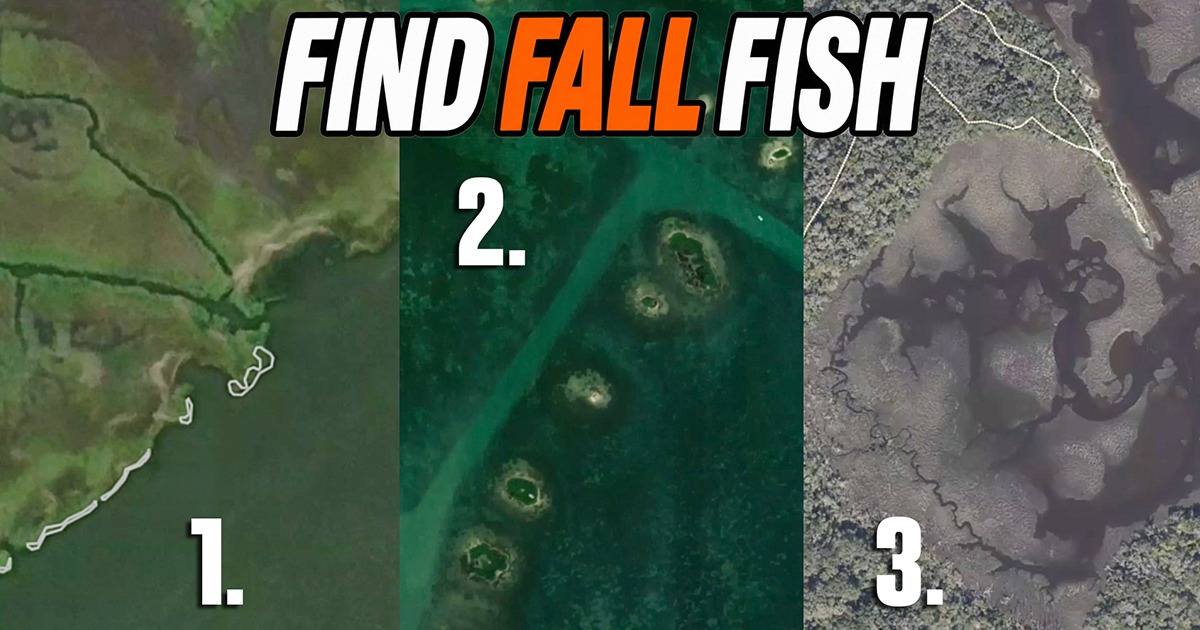
Fall can be one of the BEST times of year to catch redfish, trout, and snook.
But just because the fish are feeding doesn’t mean they’re going to be in the same spots you were catching them a few weeks ago.

As water temperatures drop, baitfish begin shifting around, and predator fish follow. The spots that were producing all summer might suddenly go quiet, while other areas start holding plenty of fish.
So where should you be looking when fall fishing patterns start changing?
There are three types of spots I like to focus on this time of year, and the best part is that you can identify them using satellite maps before you ever hit the water!

Find Better Fishing Spots Before Your Next Trip!
Throughout this lesson, I’m using Smart Fishing Spots to identify creek mouths, oyster beds, depth changes, and other features that can help put you around more fish.
Instead of guessing where to fish, you can start building a plan based on the tides, weather, and seasonal conditions before leaving home.
CHECK OUT SMART FISHING SPOTS →
1. Creek Mouths & Tidal Drains
One of the first places I look for fish in the fall is around creek mouths and tidal drains.
These areas act as natural funnels that move baitfish between shallow marshes and larger bodies of water.
During higher tides, water pushes up into the marshes, allowing baitfish and predator fish to spread out into shallow areas.
But when that tide starts falling, much of that water begins draining back out through the creeks.
And that creates some excellent opportunities to catch fish!
Redfish and trout can position themselves around these creek mouths to intercept bait as it gets pushed out with the current.
When scouting these areas, I like to look for a few additional features:
- Oyster beds: Especially those positioned just outside creek mouths or along nearby points.
- Depth changes: Deeper water near a creek opening can provide a place for fish to hold as the tide drops.
- Current seams: Areas where moving water creates opportunities for predators to ambush bait.
One of my favorite things about Smart Fishing Spots is the ability to turn on the oyster bed layer.
This makes it much easier to identify oyster beds positioned around creek mouths that might otherwise be difficult to spot on standard satellite imagery.
The key is finding areas where moving water, baitfish, and structure come together.
2. Grass Flats Near Deeper Water
Grass flats can be incredibly productive during the fall, especially when they have deeper water nearby.
As temperatures begin fluctuating throughout the season, fish often move between shallow feeding areas and deeper water.
For example, after a cold front passes through, deeper water can offer more stable temperatures.
But as conditions warm up again, fish may push back onto the shallows to feed.
That’s why I like looking for grass flats with features such as:
- Defined drop-offs along the edges of the flat
- Deeper channels or troughs running through the grass
- Sandy potholes and broken grass patches
- Shallow feeding areas surrounded by deeper water
These features give fish options as conditions change.
And that’s exactly what makes these spots so valuable during the fall!
Think about a grass flat with a deeper channel running through the middle.
When the tide drops or cooler weather moves in, fish may slide into that deeper channel.
Then, as the tide rises or the shallow water begins warming throughout the day, those same fish can move back onto the flat to feed.
Instead of searching for completely different areas every time conditions change, you can focus on spots where fish have access to both shallow and deeper water.
Using satellite imagery, I can identify these depth changes and narrow down the areas I want to investigate before heading out.
3. Wind-Protected Shorelines & Mud Flats
This third type of spot becomes especially important when cold fronts start moving through.
As air and water temperatures drop, finding areas that warm up faster can make a BIG difference.
And two things I pay close attention to are bottom composition and protection from the wind.
Look for Dark, Muddy Bottoms
Shallow areas with darker, muddy bottoms can absorb sunlight and warm up faster than some surrounding areas.
After a cold front, these spots can become attractive to baitfish and predators as conditions begin stabilizing.
This is why I like looking for shallow, muddy flats that receive plenty of sunlight, especially later in the day.
But there’s something else you need to consider.
The tide!
A muddy flat might look fantastic on a satellite map, but if the tide is too low, there might not be enough water for fish to move onto it.
That’s why it’s important to understand when these areas become accessible and when fish are more likely to move in.
Find Shorelines Protected From Cold Winds
Another important factor is wind protection.
Cold fronts often bring strong winds out of the north, northwest, or northeast.
Those winds can mix and cool shallow water, making exposed areas less favorable.
Protected coves and backwater pockets can offer better conditions, especially when the sun has an opportunity to warm the water.
However, not every shoreline provides the same protection.
For example, low marsh grass isn’t going to block much wind.
Instead, look for shorelines protected by taller structures such as trees or buildings.
A shallow, muddy cove that’s sheltered from a strong north wind could be worth checking out after a cold front, especially once temperatures begin warming again.
Final Thoughts
Finding productive fishing spots in the fall doesn’t have to be a guessing game.
The biggest thing to remember is that fish are constantly adjusting to changes in water temperature, tides, and bait movement.
A spot that produces on a warm afternoon might fish completely differently the morning after a cold front.
That’s why I recommend focusing on these three types of areas:
- Creek mouths and tidal drains
- Grass flats near deeper water
- Wind-protected shorelines and mud flats
But remember, finding a promising spot is only part of the equation.
You also need to know WHEN to fish it!
Pay attention to how the tide, wind, and temperature affect each area, and use that information to build a pattern.
If you want help identifying these types of spots, check out the Salt Strong Insider Club.
You’ll get access to Smart Fishing Spots, including handpicked fishing areas selected by experienced guides, coaches, and fishing professionals based on conditions such as wind, tides, and time of year.
It’s all about spending less time searching and more time catching!
Now I’d love to hear from you!
What’s YOUR favorite type of spot to fish during the fall? Are you focusing on creek mouths, grass flats, or protected shorelines?
Let me know in the comments!
Frequently Asked Questions
Where is the best place to find redfish in the fall?
Creek mouths, tidal drains, grass flats near deeper water, and protected shorelines can all be productive for fall redfish. The best location depends on water temperature, tide movement, baitfish activity, and recent weather conditions.
Where do inshore fish go after a cold front?
After a cold front, fish may move into nearby deeper water where temperatures are more stable. As the sun warms shallow areas, they may return to protected flats, muddy bottoms, and other feeding areas.
Are creek mouths better on an outgoing tide?
Outgoing tides can be especially productive around creek mouths because falling water moves baitfish out of shallow marshes and through narrow drains. Redfish and trout can use these areas to intercept bait moving with the current.
How can I find good fall fishing spots before getting on the water?
Satellite imagery and mapping tools such as Smart Fishing Spots can help you locate creek mouths, oyster beds, grass flats, depth changes, and wind-protected shorelines. Combining those features with tide and weather information can help you narrow down promising locations before your trip.



Open bay i cant find fish wading it’s much to cover it open bay no structural maybe some reef but that help please
Well Tony having fished inshore saltwater going on 24 years now and being someone who really doesn’t make long trips to many different places to fish i have about 4 select spots that I know from past experience where all the creekmouths are and oyster mounds but here in northeast florida unlike your central florida locations we DONT have any seagrass persay with sandy bottoms but lots of shoreline cordgrass with muddy mucky bottom and scattered as well as oyster mounds for cover on that structure with plenty of grassy points and cuts but one thing is great about all that compared to your central florida location is with dark mud for bottom composition with plenty of oysters instead of light colored sand and seagrass this is actually a better enviournment for WINTER time inshore saltwater fishing because unlike your areas light colored sand our dark muddy bottom with lots of oysters attract heat better because its a proven fact that darker colors absorb heat more then lighter colors do add dark colored oysters and you have nature’s own natural heaters that can sometimes heat the surrounding water near the oysters as much as 2 possibly 3 degrees more then the rest of the water in the area and ever since I learned that I do fairly well on seatrout and redfish in the winter I’m also going to try something new in instead of using my bigger sized shrimp lures the chasebaits flick prawn as you may know being my favorite I’m going to try the small 2 inch size that I was slaying the fish this past summer at night on under the docks considering that everything during the summer seems to shrink in size because the bigger bait seem to all vacate and head out to sea I’m going to see just how deadly the very small shrimp can be who knows? Thanks for your always great valuable Intel as always Tony and what you do🤔😉👍
I found that Texas “Spot” and gave it a highlight. I’ve fished that at other times of the year many years back. It’s a great flat
Tony, you talk about needing to be sheltered from the wind and fish on the calm side of a island or point. There is also assumption that you need to fish on the wind blown side. The wind blows bait to the shoreline. Can you comment as to why there are two different thoughts.
In the winter when water temps are at there coldest your trying to get out of the wind because the wind makes waves and because it also blows on the water the wind and waves have a tendency to stir up the water and this chills the water instead of warming it kinda like if you put a spoon in a deep glass of ice water to stir the contents to thoroughly chill it if left alone while the top with the ice would be chilled the contents on the bottom would be slightly warmer bottom line when fishing in winter ALWAYS look for the warmest water unlike summer fishing where your doing the opposite and looking for the coolest water just saying not bragging I just know because I have been fishing inshore saltwater going on 24 years now and that’s besides being a saltstrong life member since 2018 and before that a regular inside member since 2017 Goodluck I hope this helps explain things a little better😉👍
Thanks Tony! Another great easy to understand lesson. This is the first time someone from Saltstrong had mentioned that the “Hot Spots” in colors (purple, yellow and red) are not AI but based on reports/guides etc. Since so much of this app is “live info” why aren’t you using an AI based prediction tool so we can see where AI predicts the best fishing.
Great tips Tony! Good question Scott. My observation has been the spots seem to be static, but the shading changes based on conditions. Not certain, but I think there is some AI prediction modeling that goes into the shading.