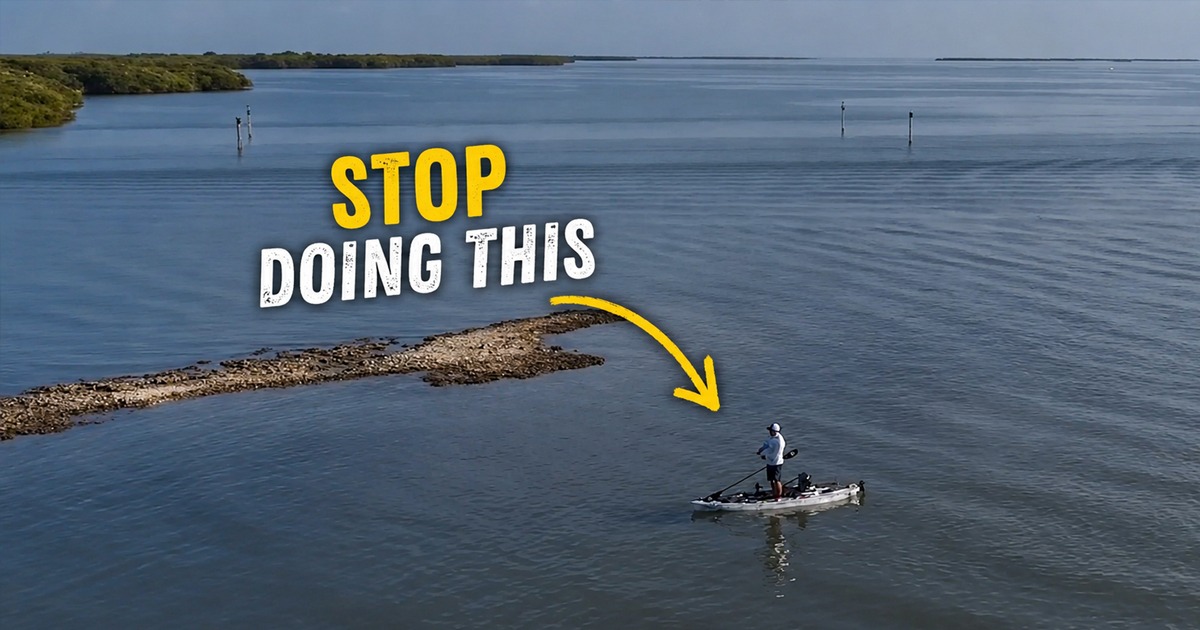
Quick question…
Have you ever wondered if YOU’RE the reason that perfect-looking spot never produces?
Because 2 incredibly common mistakes kill your chances before your lure even hits the water.
Watch the video below to see if you’re guilty of them…

Mistake #1: Running Straight to the Shoreline
When I first transitioned from bass fishing to inshore saltwater fishing, I made the same mistake almost every trip.
I’d find a promising shoreline, run straight to it, fish every inch of it, and leave wondering why I never got a bite.
The problem wasn’t the shoreline.
The problem was how I approached it.
Many anglers assume the fish are tight against the bank, but that’s often not the case. Depending on the tide, wind, water temperature, and where the bait is holding, fish may be 20, 30, or even 50 yards off the shoreline.
By running directly to the bank, you may be parking your boat right on top of the fish before you ever make your first cast.
Fish Your Way Into the Spot
Instead of driving straight to the shoreline, stop well short of your destination.
As a general starting point, I like to shut down at least 75 yards away in shallow water. The exact distance depends on water depth and conditions, but the goal is always the same:
Give yourself time to observe before you move in.
Those extra 20 to 30 seconds can completely change your game plan.
Look for:
- Schools of baitfish
- Mullet activity
- Pinfish flashes
- Nervous water
- Fish wakes or pushes
- Current seams
- Oyster bars
- Potholes
- Changes in bottom depth
These clues tell you where predators are most likely positioned.
Rather than guessing where the fish are, you’re letting the conditions show you.
Remember: Fish Move
One mistake many anglers make is assuming fish will always be in the same place.
A shoreline that held fish last week may be empty today.
Why?
Because conditions changed.
On grass flats with significant tidal movement, fish constantly reposition themselves based on water depth, bait movement, and available cover.
For example, a flat may have:
- Very shallow water near shore
- An intermediate depth zone
- A deeper edge farther out
At different stages of the tide, fish may be using any one of those three areas.
That’s why it’s so important to fish your way into a spot instead of assuming they’re already on the shoreline.
Mistake #2: Making Too Much Noise
Even if you stop far enough away, you can still ruin the opportunity if you approach too loudly.
I see this happen all the time.
Anglers shut down the outboard just a short distance away, drop the trolling motor into the water, crank it up on high speed, slam hatches, stomp around the deck, and start casting.
Sometimes they’ll still catch fish.
But many times, they’ve already warned every cautious fish on the flat that something isn’t right.
The shallower the water, the more important it becomes to stay quiet.
Think Like You’re Hunting
One mindset shift can make a huge difference.
Don’t think of yourself as driving to a fishing spot.
Think of yourself as trying to sneak up on a wild animal.
Imagine trying to walk within bow range of a deer.
You wouldn’t stomp through the woods, slam doors, or yell to your buddy.
You’d move slowly.
You’d stay quiet.
You’d pay attention to every little detail.
That’s exactly how you should approach shallow-water fish.
They’re not sitting around trying to solve puzzles.
They’re simply reacting to anything that feels out of place.
After spending their entire lives avoiding sharks, dolphins, birds, and anglers, they’ve become incredibly cautious. Any unusual sound or disturbance can be enough to send them somewhere else.
Small Changes Lead to More Fish
Successful fishing isn’t just about finding good spots.
It’s about arriving at those spots without announcing your presence.
The next time you’re approaching a shallow flat, remember these simple steps:
- Shut down early.
- Slow down.
- Observe before you move in.
- Fish your way into the area.
- Keep your approach as quiet as possible.
Those few extra seconds of patience can be the difference between fishing water that looks perfect and actually presenting your lure to willing fish.
Sometimes the fish were there all along.
The only difference is whether you gave yourself the chance to catch them.
Final Thoughts
Most anglers spend hours planning a fishing trip.
They check the tides, study the weather, rig the right lures, and pick what looks like the perfect spot.
But all of that preparation can be wasted if you make the wrong approach.
Before you ever fire your first cast, ask yourself:
- Am I stopping far enough away?
- Have I taken a few seconds to observe what’s happening?
- Am I fishing my way into the area instead of running straight to the shoreline?
- Am I keeping my approach as quiet as possible?
Those simple habits won’t guarantee a fish every trip, but they’ll make sure you’re giving yourself the best chance to catch the fish that are already there.
Because sometimes the difference between a slow day and a great one isn’t finding a better spot…
It’s approaching the right spot the right way.
Be honest… what’s one thing you see other anglers do that instantly makes you think, “They’re about to spook every fish”?



OMG Pat. The comment about the squeaky hatch registered. A year or two ago I couldn’t seem to fix the triangular bow hatch cover from creaking, so I grabbed some old foam rubber and laid it in the corners, closed the hatch lid down. Not pretty, but solved the problem.
Great lesson Pat. Very thorough and to the point. Even as quiet as we can be at times we’re spooking fish off as their camouflage is so good and or the water quality is poor which limits our ability to see them. A misplaced lure or the wrong type can really do some damage. Thanks for the reinforcement on this subject. Great reminders.
Pat,you presented some really important information. I learned way too long ago (I’m getting old) trout fishing on small streams. I was taught keep low, crouch down, whisper, cast “lightly”. Brook trout are very spooky, you can’t just walk up on them. I have carried that mind sense all through my fishing, stealth mode. I shut down my big motor well away from the area I plan to start fishing 150 yards most often more yards away. I’ll fish my way in. I also believe sonar noise will soook if not at least make fish aware of my presence. I turn off the sonar I don’t need it in 4 – 3 – 2 or 1 foot of water.
I agree with you on the sonar, I believe fish can feel and hear it.
I’m the same pond hoping. I walk softly and start making my cast before I get to the edge. They absolutely can feel your presence
Amen on “Noise”…..Here on the Chesapeake, I am fortunate to be on the Choptank, if I come outta the river to the Bay and turn North, I’ll run into a fisherman at almost every area, If I turn South, I rarely run into another angler….The nemis in my area is the guy that comes into shallow water with out a troll motor and keeps putt’n his motor in and outta gear to move….When that happens, it’s time to move on
Makes it difficult on all of us for sure!
Another great video Pat, thank you.🤗🎣🙏💯
Thanks Bob!
Great video on the stealth aspect of Fishing.
Thanks for watching!
That’s been me many times. Good post!
Thanks Javier!
Sound advise, Pat! Thanks for sharing your expertise! 🎣🧂💪🏻🔥
Thanks for watching!
Thanks Pat, lots of good intel in this video! I’ve watched bass boats for years come blowing into a cove I would be in fishing wide open, drop their trolling motor, fish 5 minutes and not catch anything, then fire it back up and blow right by me and leave all while I’m sitting still catching fish! 😂
As I was recording this video that’s the exact same scenario I was thinking about myself. I think sometimes what happens is newer inshore anglers will bring that type of behavior from the bass world or even from up north during a striper blitz.
Great video quite is the key
Thanks Charles!