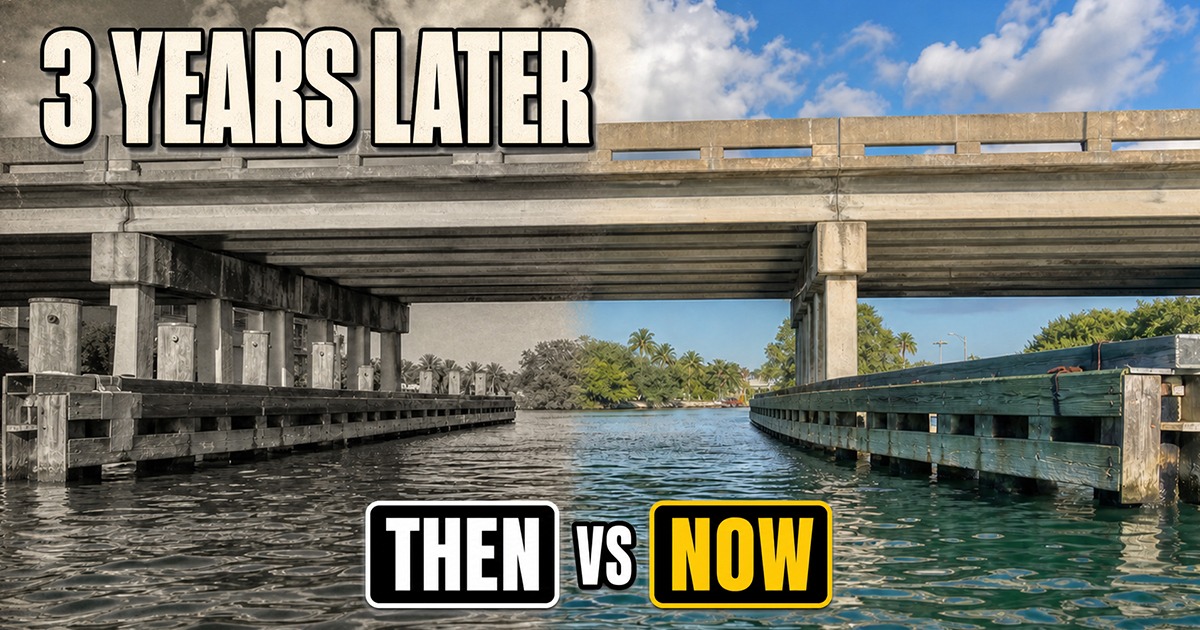
Can you really catch fish in the exact same spot three years later?
Today, we’re putting that to the test.
I’m heading back to a spot that produced years ago, during the same season, under nearly identical conditions, to see if history repeats itself… or if everything has changed.
This isn’t just about one fishing spot.
It’s about understanding why fish were there in the first place and whether those patterns still hold up over time.
Let’s hit the water and find out if this spot still has what it takes.

Featured Software:
Artificial Lure Setup:
- Rod: Slam Stick 7’6 Medium
- Reel: Otis 2500
- Lure 1: Moonwalker Topwater
- Lure 2: Prawn XT Jr. (3.5″)
- Lure 3: The Mulligan 4″ Paddletail
- Hook: Hoss Helix Hook 3/0 1/8oz
- Mainline: Diawa J-Braid 10lb
- Leader: Ande 15lb Mono Leader
Bridge Fishing Setup:
- Rod: Slam Stick 7’6 Medium Heavy
- Reel: Diawa BG MQ 3000
- Hook: Hoss Football Jighead 4/0 1/8oz
- Mainline: Diawa J-Braid 20lb
- Leader: Ande 30lb Mono Leader
The Original Summer Game Plan
This trip started around 6:00 in the morning with glass-calm conditions.
The air temperature was approximately 77 degrees and expected to climb into the 90s. Water temperature was already around 86 degrees.
That made the timing important.
During the summer, fish can move onto shallow flats and shorelines to feed early. As the sun rises and the water gets hotter, many of those fish slide toward deeper, more comfortable water.
The causeway I planned to fish had both options close together:
- Shallow shoreline habitat
- Nearby deep water
- Shade
- Current
- Bridge structure
I could start shallow and then adjust without having to run across the entire bay.
Plenty Of Bait, But Not Many Bites
The shallow causeway had nearly everything I wanted to see.
There was plenty of bait along the shoreline, larger fish were pushing wakes, and there wasn’t much floating grass to interfere with a topwater lure.
I started with three artificial lures:
- Slam Shady Moonwalker
- Prawn Jr XT
- The Mulligan in the Slam Shady color
The Moonwalker produced a nice trout along the shallow shoreline, even with a dolphin cruising through the deeper water nearby.
That fish was likely using the shallows to feed while also staying away from the dolphin.
But aside from that trout, the fish weren’t very aggressive.
There was life everywhere, but very little feeding activity.
One possibility is that the causeway lights created a productive feeding zone overnight. If those fish had already eaten heavily before sunrise, they may not have been interested in chasing lures once I arrived.
Either way, forcing the shallow-water bite wasn’t the answer.
It was time for Plan B.
Returning To A Productive Spot Three Years Later
Before this trip, I reviewed my previous catches in Smart Fishing Spots.
That’s when I noticed the bridge had produced some quality fish almost exactly three years earlier during the same time of year.
Would those fish still be using it?
There was only one way to find out.
I moved over to the bridge, watched the fish finder while circling the channel, and focused on the fender system and submerged pilings.
It didn’t take long to find fish.
My first shrimp was immediately crushed by something strong enough to break me off. Another drop produced a healthy mangrove snapper, followed by another large fish that buried itself in the structure.
The old spot was still holding fish.
Now I needed to adjust my setup so I could actually land them.
The Adjustments That Changed The Trip
I started with 20 lb leader, which wasn’t enough for the size of the fish or the amount of structure below the boat.
So I made three important changes:
- Increased my leader to 30 lb monofilament.
- Tightened the drag so the fish couldn’t immediately reach the pilings.
- Switched from shrimp to a large piece of blue crab.
The shrimp proved that fish were there, but it was also attracting smaller snapper and bait stealers.
A half blue crab created a much larger offering. That helped discourage the smaller fish while specifically targeting the heavy fish holding around the pilings.
The result was immediate.
I hooked a big fish, put pressure on it, and used the trolling motor to pull away from the bridge.
This time, the fish didn’t make it into the structure.
Plan B officially paid off.
How To Fish Bridge Fender Systems
From above the water, a bridge fender can look like one solid wall.
But underwater, many of these structures are supported by rows of individual pilings.
Those pilings create shade, current breaks, vertical structure, and reef-like habitat that attracts baitfish and larger predators.
My presentation was simple.
I dropped the crab vertically along the outside of the fender and allowed it to fall beside the submerged pilings.
The important part was being prepared before the strike happened.
I kept the trolling motor pointed away from the bridge. As soon as a fish ate, I could apply heavy pressure and use the motor to create distance from the structure.
When fishing this way:
- Keep the bait close to the structure.
- Use a leader heavy enough to handle abrasion.
- Tighten the drag before dropping.
- Be ready to move the boat immediately.
- Don’t give the fish time to wrap around a piling.
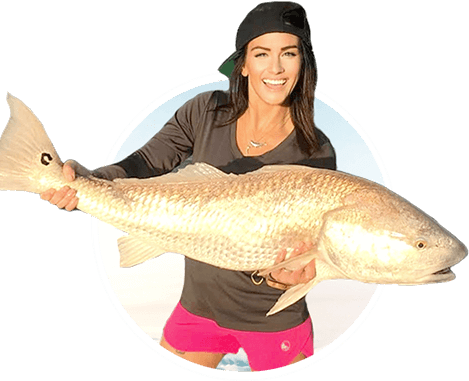
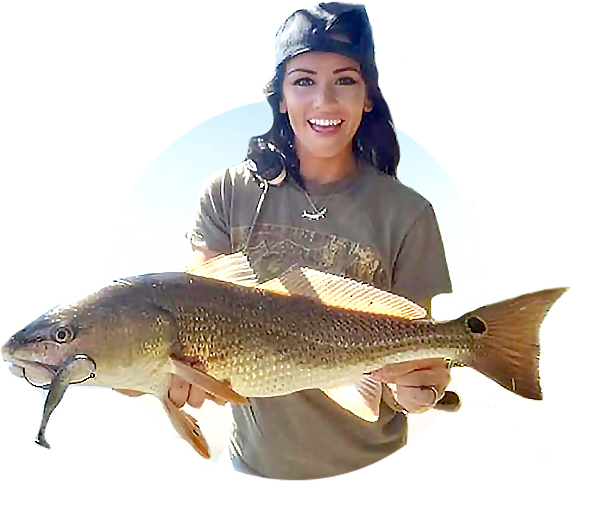
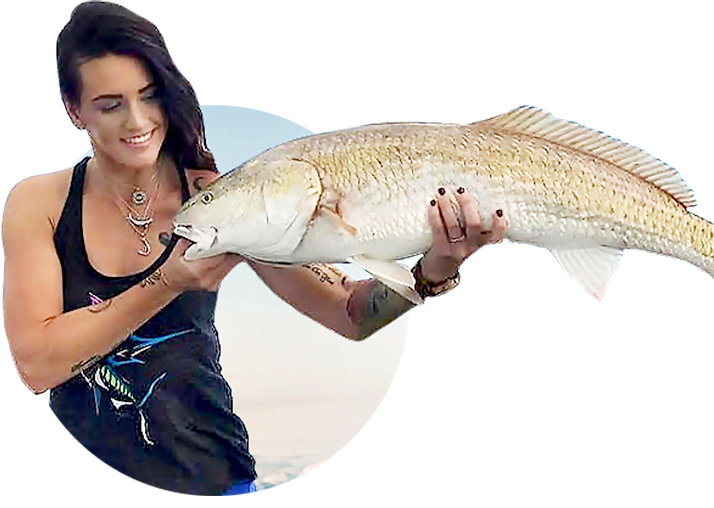
Once I made those adjustments, the bridge produced multiple quality fish, including the biggest one of the trip.
Why Fishing Catch Logs Matter
It would have been easy to forget about this bridge.
Three years is a long time between visits, and there are countless other spots that could have distracted me.
But a fishing catch log doesn’t forget.
Logging catches allows you to look back at:
- The exact location
- Time of year
- Tide
- Weather conditions
- Wind
- Water temperature
- Lure or bait
- Species caught
The goal isn’t simply to save a waypoint.
A waypoint only tells you where something happened. A detailed catch log helps explain when and why it happened.
That’s what makes the information useful.
When similar seasonal conditions return, you can revisit spots that have already proven themselves instead of starting from scratch.
The fish may not be sitting in the exact same place every year, but seasonal patterns often repeat.
In this case, a productive bridge from three years ago became the best spot of the entire trip.
Final Thoughts
The original plan was to catch fish in the shallows before the summer heat took over.
There was plenty of bait and activity, but the bite never developed the way I expected.
Instead of spending the entire morning waiting for those fish to cooperate, I adjusted.
An old fishing catch log pointed me toward a bridge that had produced during the same time of year three years earlier.
The fish were still there.
I simply had to locate them, adjust my tackle, change baits, and keep them away from the structure.
That’s why every trip should include more than one plan, and why every productive trip should be saved in your catch log.
The information you record today could put you on the best fish of your trip three years from now.
Do you regularly look back at old fishing reports before planning a trip?
Let me know in the comments!
Tight lines!



I sure do love your videos, Tony! Those were some enormous drums! I’ve been strictly artificial, but that certainly has its limits & I’m definitely going to do just what you demonstrated one of the days! Thank you!
You’re welcome Rhett and thank you for the great feedback!
Great video, thanks Tony!
You’re welcome JD!
Awesome video, I’ve started logging catches in the app for future reference. that will be a great feature once I get more data points added. My son and I have been having fun this summer catching black drum on bridge pilings.
Thanks Tomas! You can upload older photos and they will pull the info from the day they were caught as long as it isn’t a screenshot.
Great video Tony! It’s interesting seeing video of you fishing the NE side of the causeway. It looks really good over there but too far by kayak. Your plan B paid off with those brutes!
Thanks Mario! I’ve made the trek on a kayak a couple times (when the launch area closer to the causeway was still open) but yeah its a loooong way to go
Great report Tony! I’m always looking at my catches from the same time as previous years and more often than not find the fish in the same places.
Thanks Dave!
Great video Tony! I caught some big black drum around the pilings at the Ocklocknee Bridge in June. I was using dead shrimp on a Hoss Helix football jig in the quarter once, as the current can get swift around those pilings. unable to get live shrimp this time of year. I
ll have to try blue crabs, otherwise Im catching mangrove snapper and everything else till a black drum commits. Big black drum will definitely test your equipment. I also caught the three drum on my last trip hanging in the shade on the north side of the bridge. Thanks for the video and tight lines!Thanks Robert! Yeah a heavier jig head will be better if the current is stronger. The 1/8 oz worked here since there was very little water movement and allows the bait to sink slower so the fish can see it.
Nice black drum Tony! Thanks for providing the detail on the type of bait used and the rod/reel combo along with the type of braid and leader used.
You’re welcome Roy!
Great video Tony. I’ve always thought of the large black drum as a ‘marine underwater tractor’. They can definitely pull.
They are definitely tanks!
Another great report. Especially the advice to fish shallow early and then go deep.
Thank you for the great feedback Jim!
To me that question is a common sense one to ask because as long as there is some kind of structure and cover there then of coarse there will still be fish there because its a circle of life thing the structure and cover attract bait and obviously the bait attracts the predators and I know for a fact this analogy is right because for at least 10 years now in a row I have BEEN fishing the same areas at night and am still catching fish there on a regular basis but as for using the catch log feature in smart spots app only my reports that were made AFTER 2024 can I read in complete detail I even reported this complaint when I asked about it a month ago and was told that because the smart spots app was so new in 2024 detailed reports would not completely be able to be read and thats what I found out because any report I made prior to last year of 2025 my sentences were cutoff in mid sentence which I found very frustrating besides the fact that since I have been a saltstrong member since 2017 and a lifer since 2018 that’s a heck of alot of reports that I did that the majority are pretty much useless that’s why I really don’t use the smart spots app very much because unlike alot of anglers that travel alot I don’t and have been fishing the same areas for many years now thanks for the info and all you do🤔
I also should say because I failed to mention the trolling motor tactic I use as also when fishing residential docks at night i found out years ago that to land the big fish you need to immediatly point the trolling motor in opposite direction of the dock and put it on high and literally pull the fish away from the pilings so as not to get cut off from the barnacles that are usually on them the trick is to have your drag tightened enough to gain line but not to much to break it but experience taught me that and after almost 24 years fishing inshore saltwater I have gotten pretty good at it not bragging just saying
I fish bridges quite often and they are more productive at certain times of the year than others, and some bridges are better than others. Also a spot is just a spot. Gotta know how to fish it the right way!