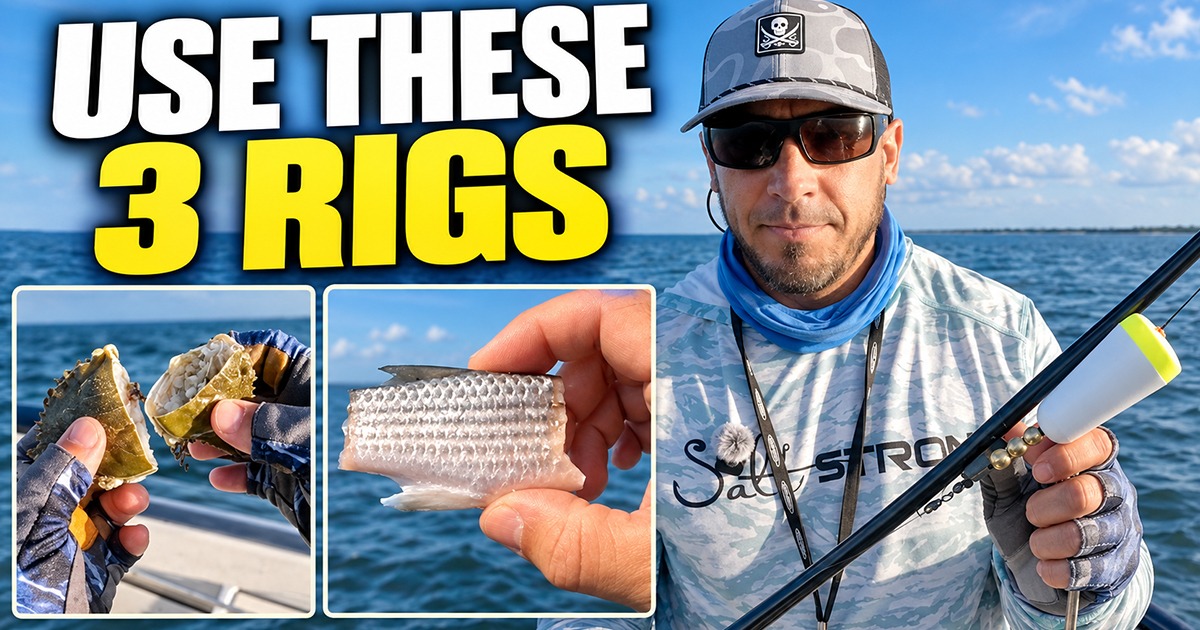
Most anglers make cut bait WAY harder than it needs to be.
In fact, 3 simple rigs will cover just about any shallow-water situation you’ll run into.
But the rig is only HALF the equation.
There’s one other detail that can mean the difference between quality fish and feeding catfish all day.
Check out this video and you’ll be ready to catch more fish on cut bait the next time you hit the water.

Featured Gear
- Rod: Slam Stick Medium
- Reel: Otis 2500
- Popping Cork Rig: Dr. Popper
- Freeline Rig: Gamakatsu Circle Hooks
- Leader: 20–30 lb Ande Mono
Salt Strong Insiders can save 20% on eligible tackle at Fish Strong.
1. Freeline Rig: The Simple Go-To
This is about as simple as cut bait fishing gets.
Tie an inline circle hook to your leader, add your cut bait, and that’s it.
No weight.
This is the rig I use most often when fishing shallow, relatively clean water without a bunch of grass or structure along the bottom.
Without a weight holding everything in place, your bait can naturally move with the wind and current.
That’s a GOOD thing.
Position yourself upwind or upcurrent from the area you want to target and let the bait slowly work toward it.
Your bait moves naturally while its scent gets carried directly toward the fish.
For most open-water situations, 20 lb monofilament leader is plenty.
And make sure you’re using an inline circle hook, especially if you’re putting your rod in a rod holder and letting the fish hook itself.
2. Knocker Rig: When You Need More Control
Take that same basic setup and add an egg sinker that can slide down your leader to the hook.
Now you’ve got a knocker rig.
This is the next rig I’ll reach for when the water gets a little deeper or the current gets strong enough that my bait won’t stay where I want it.
For example, you might be fishing 3 to 4 feet of water and notice your freeline bait constantly rolling away from your target.
That’s when some extra weight can help.
The exact weight depends on the conditions.
You don’t need to automatically grab the heaviest sinker in your tackle box.
Use just enough weight to control your bait based on the depth and strength of the current.
That keeps your bait in the strike zone without making the presentation unnecessarily heavy.
3. Popping Cork Rig: Grass, Structure & Dirty Water
Sometimes you DON’T want your cut bait sitting on the bottom.
Thick grass, oyster bars, and other structure can quickly bury your bait or leave you constantly snagged.
A popping cork solves that problem by suspending your bait just above the structure.
For this setup, I use a short section of 30 lb leader between my braid and the top of the cork.
Below the cork, I’ll typically use 20 lb leader down to an inline circle hook.
The length of that bottom leader depends on the depth and how high the grass or structure comes off the bottom.
The goal is simple:
Keep your bait right above it.
There’s another advantage here, too.
In dirty water, the popping cork creates additional sound as it moves around in the waves. That noise can get a fish’s attention before the scent of your cut bait helps close the deal.
Where You Throw Cut Bait Matters MORE
You can have the perfect cut bait rig and still waste an entire day.
That’s because cut bait isn’t something you should randomly throw into the middle of a giant flat and hope a good fish eventually smells it.
Instead, look for areas fish naturally use to travel and stage.
One of my favorites is the edge of a flat where shallow water transitions into slightly deeper water.
Those edges can act like highways for fish moving between feeding areas.
Another great option is a deeper trough running alongside a shoreline.
Pay attention to which direction the wind and current are moving. Position yourself so the scent from your bait travels through the area you’re trying to target.
And don’t ignore points, oyster bars, and other staging areas connected to those travel routes.
If a deeper trough leads toward a point, for example, fish can use that trough as a highway before stopping around the point to feed.
Finally, look for life.
Baitfish. Diving birds. Surface activity.
Those clues can turn a massive stretch of water into a much smaller target zone.
If you don’t get a bite after about 10 minutes, move down and try the next high-percentage area.
You’re still covering water, just much slower than you would with artificial lures.
Final Thoughts
You don’t need a dozen complicated rigs to fish cut bait effectively.
A freeline rig, knocker rig, and popping cork rig will cover the vast majority of shallow-water situations.
The bigger key is knowing when to use each one and putting your bait somewhere quality fish are actually likely to travel or feed.
That’s where planning your trip ahead of time can make a huge difference.
If you need help identifying depth changes, points, structure, contours, and other high-percentage areas in your local waters, Smart Fishing Spots can help you narrow down where to start before you hit the water.
Which of these three cut bait rigs do you use most often? Or do you have another way?
Let me know in the comments!
Frequently Asked Questions
What is the best cut bait rig for shallow water?
A freeline rig with an inline circle hook is a great starting point when fishing shallow water with relatively clean bottom and manageable current. It allows your bait to move naturally with the water.
When should I add weight to a cut bait rig?
Add weight when stronger current or deeper water causes your bait to move too far from your target area. A simple knocker rig allows you to add enough weight to keep the bait under control.
Should I use a circle hook for cut bait?
Inline circle hooks are ideal for this style of fishing, especially when you’re placing the rod in a rod holder and allowing the fish to hook itself. Avoid offset circle hooks if your goal is to reduce the chance of deeply hooked fish.
When should I use a popping cork with cut bait?
Use a popping cork when fishing over grass, oyster bars, or other structure where you want to keep the bait suspended off the bottom. It can also provide additional sound and attraction in dirty water.
Where should I throw cut bait?
Focus on areas fish use as travel routes or staging areas, including flat edges, deeper shoreline troughs, points, oyster bars, and depth changes. Visible baitfish, birds, and other signs of feeding activity can help you narrow down the best places to fish.
What can I use for cut bait?
Mullet, ladyfish, pinfish, shrimp, and blue crab can all be used as cut bait. The best choice will depend on the forage available and the species you’re targeting.



Thanks, Tony! Nice presentation! 😎🎣🧂💪🏻
You’re welcome James!
Awesome, appreciate the break down.
You’re welcome AJ!
Thx Tony, great video as normal. I use all the rigs you show plus Texas Rig (bullet weight) and a Carolina rig.
You’re welcome Jeff!
Thanks Tony great information I use these all the time and use all your other baits as well
You’re welcome James!
Great tips Tony, thank you very much! – Wes
You’re welcome Kristin!
Thank you sir
You’re welcome Kevin!
Excellent video Tony. You’re very good at editing and making great instructional videos 🤜🤛.
I keep those rig types ready on @75% of my poles. The other 25 % is for The 2.0 or the Prawns
Thank you for the great feedback Dave!
Great video and info Tony. In my area, I always use the freelined rig. Just a hook, no weight. The only thing I do different is I always snell the hook with an upturned eye instead of tying a knot.
Thanks Brian! Yeah those style eyes on the hooks are great for snelling. A regular knot snug to the eye works as well. Learned that from Capt. Peter Deeks (he was catching monster fish so it has to work haha) Only thing I wouldn’t tie to them is a loop knot.
Thanks Tony. Good information
You’re welcome David!
I guess its because not all saltstrong members use lures so you do articles on using both live and dead bait because I know you Tony your very efficient at using lures so why would you bother with the STINK and or the hassel of both gathering your own bait or the expense of buying it and or the hassel of keeping live bait alive and dead bait fresh? Because to me using bait is way more complicated and dull of hassels the using lures anyday and like i have always said if it takes more work then fun why bother?! And to me bait does just that just saying! Thanks for the info and what you do🤔😉👍
If it’s inshore fishing, we try to touch all bases! I actually enjoy using cut bait, especially when the bite is tough or fishing popular areas where the fish have seen every lure imaginable and are highly pressured. Seeing the rod dip over and drag start screaming is a rush!
Try night fishing you would be even more amazed thanks for the reply🤔