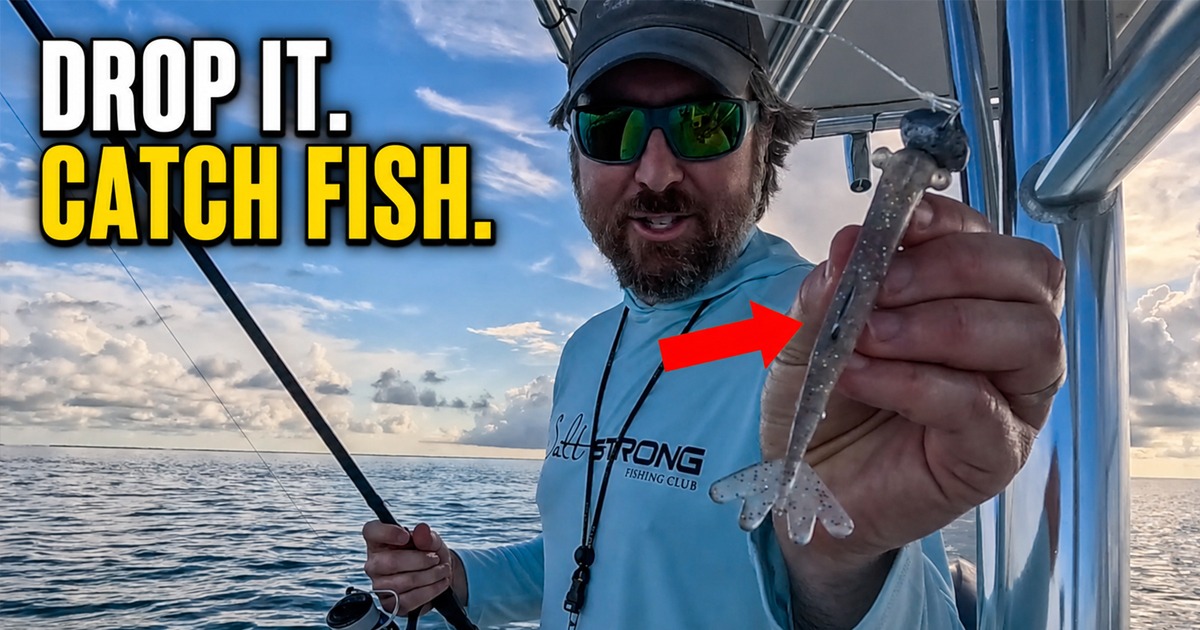
One lure.
One drift.
A whole lot of action.
I headed to Boca Grande Pass to test the durability of the new Prawn XT, and I chose one of the easiest ways to put it in front of a ton of fish: dropping it straight down and bouncing it along the bottom as I drifted through the pass.
Watch the video below to see this easy jigging technique in action, and how the lure held up through it all.

Featured Software:
Featured Gear:
- Rod: Slam Stick Medium-Heavy Power
- Reel: Saltist MQ 3000
- Line: 20 lb J-Braid 8 Grand
- Leader: 30 lb Ande Monofilament
- Lure: Prawn XT 4.3″ rigged on 3/4 oz Hoss Weedless Football Jighead
How to Catch Saltwater Fish by Vertical Jigging Passes and Inlets
The technique is incredibly simple.
Position your boat at the beginning of a productive stretch, drop a weedless shrimp lure to the bottom, and let the current carry you through the pass.
Use short, controlled lifts to make the shrimp rise and fall. Most strikes will come as it drops back toward the bottom.
The biggest key is keeping your line as vertical as possible.
I used the trolling motor to stay over the lure instead of letting it trail far behind the boat. This made it easier to:
- Feel the bottom
- Detect light strikes
- Avoid snags
- Pull grouper away from structure
The action started almost immediately.
I missed a few smaller taps before hooking a solid grouper near a drop from approximately 40 to 60 feet. More grouper, mangrove snapper, and jacks followed as we drifted through the pass.
At times, the lure didn’t make it through more than a few bounces before another fish hit.
How to Find Productive Ledges, Holes, and Bottom Structure
You can drift randomly and catch fish, but knowing what’s beneath the boat makes this technique much more effective.
I used the high-resolution shaded-relief imagery inside Smart Fishing Spots to locate:
- Deep holes
- Rocky ledges
- Underwater boulders
- Sharp depth changes
I could watch the boat drift across those features in real time and anticipate when the bottom was about to get deeper or shallower.
That matters because the best action often occurs along the edges of holes and ledges.
Grouper and snapper use those areas to hide from current while waiting for shrimp, crabs, and baitfish to pass overhead.
Once we drifted beyond the main structure, the bite slowed dramatically.
That’s your clue to return to the productive area and make another pass. Don’t keep drifting across empty bottom and assume the fish suddenly stopped biting.
How to Rig a Weedless Shrimp Lure for Deep-Water Jigging
Passes and inlets hold fish because they contain structure, but that same structure can steal a lot of tackle.
A weedless setup allows you to bounce the lure through rocks, ledges, and uneven bottom with fewer snags.
For this trip, I rigged the Prawn XT on a 3/4-ounce weedless football-style jighead. That was enough weight to maintain bottom contact in 40 to 70 feet of water with minimal current.
Use the lightest jighead that still lets you feel the bottom and keep your line reasonably vertical. Shallower water and weaker current will usually call for less weight.
The lure also needs to sit straight.
Insert the hook through the center of the nose, bring it out through the underbelly, and slide the lure firmly against the jighead. Then mark where the hook naturally meets the body and push it straight through.
A properly rigged lure will fall naturally without spinning or bunching.
The Prawn XT’s durability was the biggest surprise.
The lure featured in this video had already been used on six trips and caught at least 40 fish. After another drift filled with fish and missed strikes, the head and tail were still intact.
That means more time fishing and less time reeling up from 70 feet to replace torn soft plastics.
When You Need an Easy Way to Find Action
This is one of my favorite techniques when the current is weak, the wind disappears, or the regular inshore bite gets tough.
Instead of running around searching for active fish, locate a pass or inlet with good depth changes and hard structure. Then let the boat carry a weedless shrimp past the fish.
It works particularly well during summer, when warm water pushes many species toward deeper areas with stronger water movement.
And the species list can get interesting.
Depending on where you fish, this same setup could produce:
- Grouper
- Mangrove snapper
- Redfish
- Snook
- Flounder
- Sheepshead
- Tarpon
- Cobia
That mystery is part of what makes it so much fun.
Every drop could produce a different fish, and when the boat passes through the right stretch, the strikes can come unbelievably fast.
Final Thoughts
This is one of my favorite ways to find action when the current is weak, the wind disappears, or the regular inshore bite gets tough.
Find a pass or inlet with good bottom structure, drop a weedless shrimp lure straight down, and keep it near the bottom.
That simple approach can catch grouper, snapper, redfish, snook, flounder, sheepshead, and plenty of surprise species.
Best of all, you never know what will be on the other end when the rod bends.
Find the structure, keep your line vertical, and hold on!
Then come back and let me know what you caught in the comments!



Sure is nice to be kept busy CATCHING when FISHING!
Looks like fun. I bet this would work great also on the offshore reefs!
Hey Luke! Thanks you for your videos. I always enjoy them. I was wondering if the xt version prawns react to the the standard prawns like z man material does. If the two materials sit next to each other they eventually fuse together.Thanks.
Hey Luke, been loving the videos using the Smart Fishing app and MH tackle to fish bottom structure near and off shore. Prior to the high res capability in the Shaded Relief Map Layer being incorporated into the App, I purchased several shaded relief chips for my Simrad for many hundreds of dollars and I find the Smart Fishing App “High Res” Shaded Relief far superior. I have no idea how u guys pull this off for such a cheap yearly price. So impressed.
Living in S. Fl, good inshore fishing is capable but limited without long commutes. So, could u put together some more videos using ur technique of bottom fishing near and offshore coupled with picking spots using the “Hi Res” and why u picked those spots and ur results?
I plan on doing something similar cause the near shore and off shore is much closer for me. I have marked all sorts of way points I want to fish using simular theories you have taught us for inshore ie; structure, reef gaps, isolated holes, etc. I’m hoping this theory works cause the public artificial reef spots get hammered around here.
I also have also noticed that many of public artifical reef marks do not match up with actual bottom structure. I find that odd. Can u explain? Looking forward to ur thoughts.
i
Always enjoy learning more. Great video. Thanks
Thanks for making time to post the nice comment Richard!
Good info Luke. This new prawn’s longevity in the water is a game changer in that there’s no need for the “Z”anymore. I’ll be ordering a pack or two soon.
Yes, you’re going to love these new Prawn lures.
Very interesting. Thanks for the explanation on how to fish this bait.
Our pleasure Troy!
Awesome video, and excellent idea to use the high res. I have fished an inlet on the east coast that goes between 30-50 feet of water. I’ve had the tail bitten off a few times near the bottom. I may have to try these in that area.
Yes, definitely give this XT verson a try there because it can hold up well to a lot of abuse from toothy predators.
I clicked on the link for the deep water prawn action video! Awesome! Going on a red snapper plus whatever else I can catch trip next week. Going to use the prawn and see how it does compared to my buddies using the regular set ups with cut squid.
Please keep me posted on how you do… I’ll be surprised if you don’t bring home the most meat because the lures do a great job at weeding out the smaller fish that have to be thrown back. And the bigger snapper and even grouper seem to love it.
Note: Just be sure to use a rod with a good backbone because the hookset gets tougher the deeper you go due to the line bowing out. The MH powered Slam Stick is my favorite by far for vertical jigging these Prawn XT lures.
Sure will, thank you!. Ordered two packs already!
Thank you, thank you thank you great video. I don’t fish this area much it 2 1/2 hours for me by Boat. But during the summer, I certainly am going to try this area the way that you advise us. Thanks again. Say hello later to Otis for me.
Will do. This method of fishing has worked in all deep structure zones that I’ve fished it so far. So I’ll be surprised if you don’t get into some fun action in whichever pass/inlet you try… the key is simply to bounce it along the bottom as close to the rocky ledges/holes as possible.