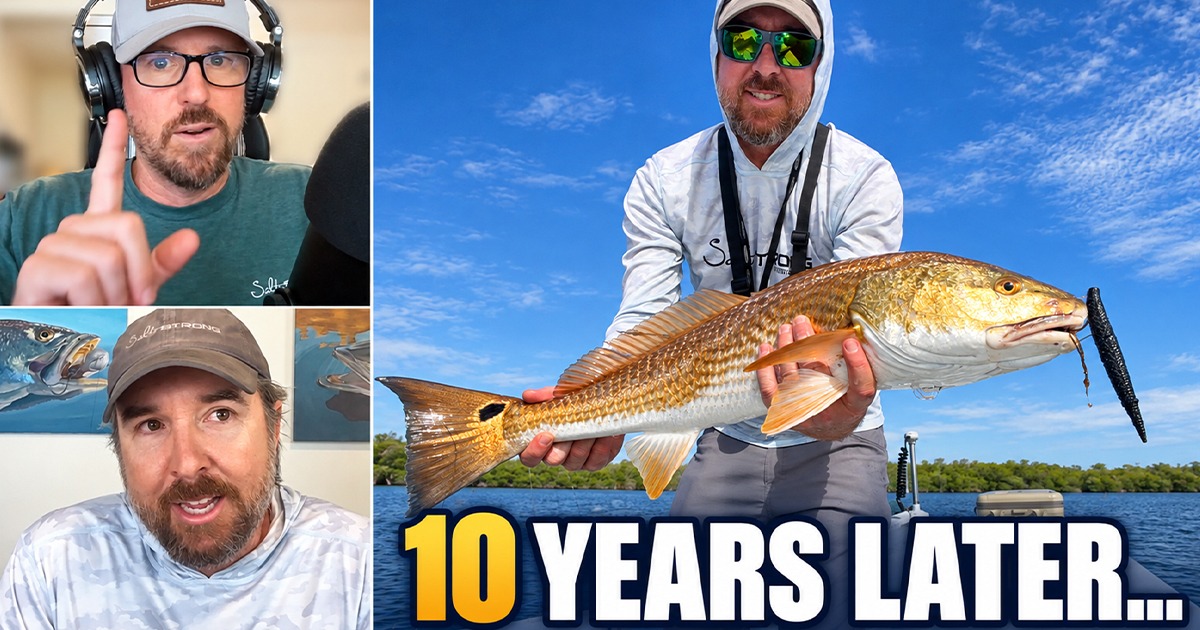
Ever wonder what would happen if you went back to your BEST fishing spot from 10 years ago?
I just did.

This was a stretch of the Indian River where we used to catch big trout consistently.
But after the seagrass disappeared, it was tough to even look at the place.
Then I heard some encouraging reports and decided to make the trip.
I showed up expecting a big trout bite. What actually happened? Let’s just say the fish had OTHER plans.
You’ll see how to adjust when a promising spot isn’t producing, so you can spend less time running around and more time getting bites.
Watch the video below to find out what happened when I went back.

Featured Gear
- Lure 1: Polk County Tweaker
- Lure 2: Skinny Lipper
- Rod: Slot Machine
- Reel: Otis 2500
Line setup: 8-pound braid, a 12-pound mono leader, and a short 20-pound mono bite tippet.
Look for Life Before Giving Up on a Spot
Years ago, this area had beautiful grass flats and some incredible trout fishing.
On a previous visit, those flats had turned into mud, and the water was murky. It was a pretty sad sight.
This time, the section I fished had grass growing again. It wasn’t all the way back, but there were mullet everywhere and pinfish flashing below.
That gave me a reason to stay, even when the first drift produced nothing but a few weak topwater strikes.
I knew there was life in the area. I needed to figure out what the fish would eat.
A slow first pass doesn’t automatically mean you picked the wrong spot.
Try LESS Action When Fish Are Spooky
Once the sun came up, the wind was light and the water was calm.
I switched to a Black Ice Tweaker and did something I rarely did back when I fished this area regularly.
I stopped twitching it.
Instead, I slowly dragged the lure just above the grass in roughly 12 to 18 inches of water.
When I spotted a redfish cruising, I cast ahead of it and brought the lure across its path.
And those reds were pouncing on it.
In those calm conditions, I suspect the extra disturbance from my earlier presentations was putting fish off. That quiet, steady retrieve made a big difference.
But that doesn’t mean you should NEVER twitch a jerk shad.
Later, the wind picked up and disturbed the surface. Adding twitches helped get their attention, and that’s how I caught my biggest snook of the trip.
Let the conditions and the fish’s response guide how much action you give your lure.
Rethink Your Color and Leader Choices
Ten years ago, I wasn’t throwing black lures in bright, clear conditions.
Now, black has become one of my first choices when it’s sunny, calm, and the fish are finicky.
That change came from comparing light and dark lures on the water. In those comparisons, dark colors have often done better in conditions where I used to automatically reach for white.
On this trip, Black Ice earned its place.
I also went lighter with my line: 8-pound braid and a 12-pound mono leader, with a short 20-pound mono bite tippet.
The idea was to keep the presentation subtle while adding abrasion protection near the lure.
My own abrasion tests are why I now prefer mono leaders. In the comparisons I’ve done, mono outperformed the fluorocarbon I tested, including when I compared similar diameters.
That setup helped me land an unexpected big snook. Although I normally use a heavier bite tippet when expecting snook, I had rigged this one with trout and redfish in mind.
Fish the Same Water With a Different Approach
I drifted through the same stretch THREE times.
Each pass got better.
In the past, I might have left after the first drift and run several miles to another spot. This time, the bait and activity convinced me to give those fish another look.
The second pass produced redfish and snook. The third brought more snook, including the biggest one.
The big trout I came for?
I saw one follow the lure, watched its mouth open, and set the hook before I felt the bite.
Yep. Pulled it right out of its mouth.
Still thinking about that one.
But I caught more redfish and snook in that zone than I ever had before. Returning to familiar water with a different approach made for a very different trip.
Final Thoughts
Your old favorite spot might still have plenty to offer.
Start with what’s in front of you today: the habitat, the bait, the conditions, and how the fish respond.
If those signs look good, try changing your presentation before firing up the motor.
Sometimes the next productive spot is the one you’re already fishing.
Have you returned to a favorite fishing spot after years away? Did your old approach still work, or did you have to change things up? Let me know in the comments!
Check Out the Polk County Tweaker Here
Frequently Asked Questions
How did you retrieve the Tweaker on this trip?
In the calm water, I used a slow, steady retrieve with no twitches. I moved it just fast enough to skim above the grass. When the wind picked up, I added twitches.
What lure color worked best for you?
Black Ice was the productive Tweaker color on this trip. Black has also become one of my go-to options for bright, calm conditions based on my recent lure comparisons.
What line setup were you using?
I used 8-pound braid, a 12-pound mono leader, and a short 20-pound mono bite tippet. When I’m specifically expecting snook, I typically use a 30-pound bite tippet.
Why did you keep fishing the same spot?
There was returning seagrass, plenty of mullet, pinfish, and some strikes. Those signs gave me a reason to change my approach before changing locations.
Is the seagrass back throughout the Indian River?
I can only speak to the section I visited. That area looked better than I expected, but it wasn’t back to what I remembered from its best years. More exploring is needed to see how other areas are doing.



Awesome Info ! and look forward to seeing the trip video. I’m from Michigan and have vacationed to Sebastian over 40 years, it was very sad to see the grass disappear and fishing suffer, hope it begins to rebound. Thanks again for all the Info and vids you guys do, keep it up! Hope to see you on the water some day !
Thanks for the kind words David! The fishing report from this trip will be posted on Friday, so keep an eye out for it.
Based on how much fun I had that day, I’ll definitely be making more trips over to the Indian River. Hope you see you out there.
What knots do you use to tie the tippet to the main leader?
I use the blood knot for that connection because it’s very strong while having a small profile without tags sticking out. Here’s a link to see a video on how to tie it along with the other knots I use for my leader assembly: https://www.saltstrong.com/fishing-school/advanced-module/knots/
Thank you for the great info.
Thanks for the great information as always very informative and I love my travel rod it fishes awesome wondering if a person can get the heavy tip part for it yet thanks again
som really good info here. Thanks for sharing.
Weedless do you have to set hook the side because straight up does not work
I lived in Fellsmere for over 22 yrs, fishing the Indian river from Ft pierce to Mosquito lagoon! I left Vero when the water quality became so bad that literally most if not all the seagrass died. I never had a problem catching big trout, actually getting two over 30″! One wading the Sebastian river by the bridge, the other wading the Wabasso shoreline.I fished by boat from Ft Pierce to Mosquito lagoon weekly! The problem that was discovered was the same continual issue that plaques Tampa consistently! Runoff from the lake was allowed to flow east, uncontested, emptying out at Taylor Slew right at Ft Pierce inlet! Results were terrible, algae blooms so thick the Sportsfishing boats in the marina could not start their engines because the green goo was so thick it would suck up into the intake and clog the manifolds,,. This bloom went all the way up the lagoon past Vero. The inlet and all the grass flats turned dark brown, the grass died and the smell was horrific! Went to many town hall meetings to see what was being done without any valid solutions being put out, lots of talk, no action! I moved thinking this would kill this area for a very long time! Now 14 yrs or so later it seems like its coming back! Not from any help by local gov! Thats a very good thing! Glad to hear great reports from this area!
Thanks so much for sharing the local insights Robert! Huge congrats on the 30+ inch trout that you have caught… that is high up on my bucket list.
Taylor Creek dumps out directly at the Ft. Pierce Inlet, where the massive flushing action pulls the vast majority of that water either straight out to sea on an ebb tide or moved south by tidal flow toward the St. Lucie sub-basin. Easy to see from an airplane or helicopter as the large brown plume outside the inlet is a give away.
The issues plaguing Sebastian and Vero Beach are largely home-grown, stemming from their own distinct watersheds. Those water pollution problems don’t stem from Lake O polluted water which has a devastating impact on the southern part of the IRL. The public outcry against Lake O releases go back 25+ yrs., long before the substantial decline of seagrass in the central IRL. Scientific studies by the South Florida Water Management District and environmental groups show that inflows from northern tributaries like Taylor Creek actually degrade the water quality of Lake Okeechobee by fueling harmful algal blooms within the lake itself, rather than the pollution coming from lake discharges into the creek.
Both cities have their own major tributary, the St. Sebastian River, which suffers from severe agricultural and urban stormwater runoff, including from Fellsmere. This river drains vast networks of agricultural canals from Indian River County, dumping excess nutrients, suspended muck, and freshwater directly into the central lagoon basin. Much of the algae and poor water quality in Vero Beach and Sebastian is also fueled locally by residential fertilizer runoff, aging septic tanks leaking into the groundwater, and stormwater drainage systems from local urbanization.
In short, Taylor Creek is an ecological nightmare for Fort Pierce and areas to the south, but it is physically impossible for it to be the scapegoat for the water quality issues in Indian River County. The state and local governments, as well as private money, are funding numerous projects to improve water quality both in Indian River and Brevard counties. The uninformed and misinformed public often ignore problems in the making over decades, and then expect an instant magical solution. It often takes a relative short time to create a problem, and a much longer time to resolve it, and usually after substantial cost to those who pay taxes. It’s never been so obvious as it is in current America where the consequences of today’s protracted problems have their roots in destructive decisions made years/decades ago.
Great info. Thank you
Our pleasure Richard!
In the 60’s and 70’s the Indian was a great producer of very big trout and very big redfish. It was incredible. Mullet fisherman really ruined it though. They were eventually forced to change occupations. And things slowly return to the old days.
I’m sinced retired to the Williston area and fish Cedar Key or Yankeetown. You can only find clear water about 3 miles out from Cedar Key or Yankeetown. I struggle with the dirty water there putting and fish in the boat. ( catch/release only). Perhaps you may have some suggestions on how I can improve my chances.
Thanks
I have been to Cedar Key a few times, and I have really been impressed with it. When fishing murky and churned zones, I default to the wake mullet as shown in the first link below.
Otherwise, I most often just use the same soft plastics that I go with down in Tampa and target the exact same types of spots (zones with good structure, mullet/baitfish activity, and some water flow).
https://www.saltstrong.com/articles/big-slam-on-lures-new-spots/
https://www.saltstrong.com/articles/lure-change-cedar-key-80-inch-slam/
https://www.saltstrong.com/insiders/smart-fishing-spots-vacation-insider/
Can’t wait to try the Black Ice
I hope you enjoy it as much as I have.