When fish are feeding aggressively, the ability to cover more water without spooking fish can make a huge difference in your catch results.
And one of the easiest ways to do that is by casting farther.
But that raises a couple of interesting questions…
1. Which lure actually casts farther: a plug or a paddletail?
2. How much farther exactly can one outcast the other?
I’ve noticed differences over the years, but I wanted real numbers.
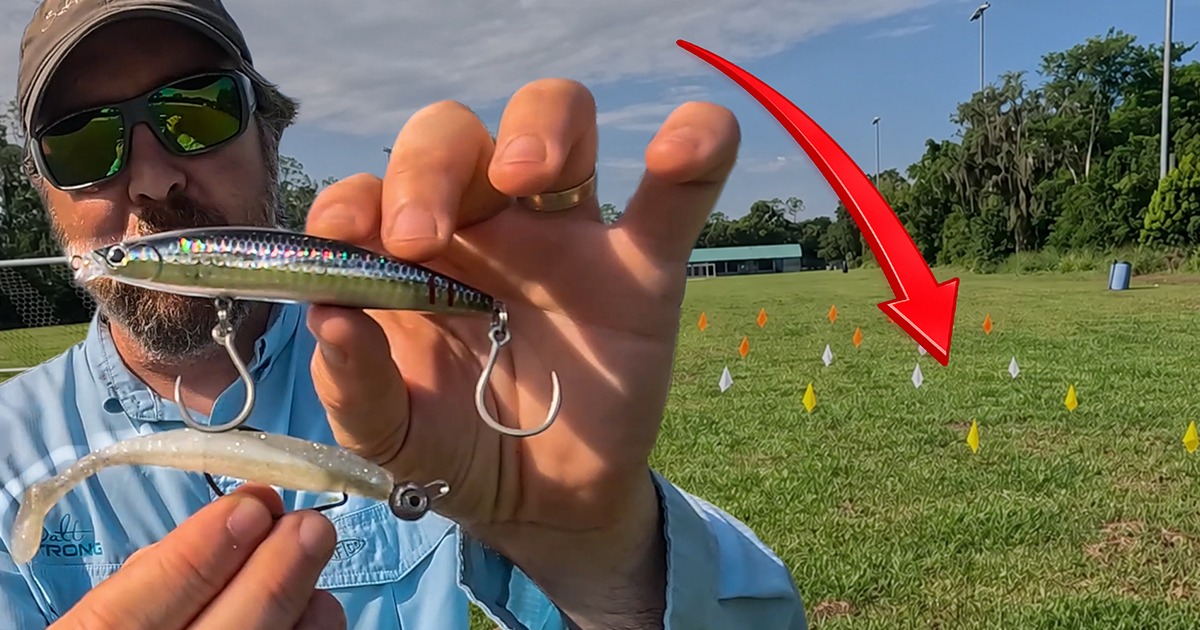
So I decided to put the longest-casting 4-inch plug I’ve ever used against the longest-casting 4-inch paddletail I’ve ever used in a head-to-head casting distance test.
Note: I weighted the paddletail with a jighead to make sure they were equal in weight.

Featured Gear
- Rod: Slot Machine 7’6″ Medium Power
- Reel: Otis 2500
- Line: 10 lb J-Braid 8 Grand
- Lure 1: Skinny Lipper
- Lure 2: Mulligan Paddletail rigged on 3/0 Weedless Round Eye Jig Head 3/16 oz
- Luke 3: Mulligan Paddletail rigged on 3/0 Hoss Helix Hook 1/8 oz
The Test
For this experiment, I compared:
- Skinny Lipper (4″)
- Mulligan Paddletail (4″) rigged on a 3/0 Weedless Round Eye Jig Head 3/16 oz
- Mulligan Paddletail (4″) rigged on a 3/0 Hoss Helix Hook 1/8 oz
The Results
Here’s how the tests ended up after averaging out the distances they traveled:
- Mulligan On Hoss Helix Hook: 105 feet
- Mulligan On Weedless Round Eye Jig Head: 118 feet
- Skinny Lipper: 135 feet
The shortest cast with the Skinny Lipper was still longer than the best cast from any of the paddletail setups.
In other words…
The plug wasn’t just winning… it was dominating.
Why Does It Matter?
An extra 15 to 30 feet may not sound like much at first.
But over the course of a fishing trip, that can be significant (especially if you’re fishing next to someone who can’t cast as far).
To put it in perspective, an extra 30 feet per cast means you’ll cover an additional football field of water every 10 casts.
Longer casts allow you to:
- Cover more water
- Reach fish before they see the boat
- Present lures farther away from potential disturbances
- Increase your chances of connecting with larger, more cautious fish
That’s especially important when targeting bigger redfish, snook, trout, and flounder in shallow water.
Why The Plug Casts Farther
The biggest factor is design.
The Skinny Lipper features weight-shift technology that moves weight toward the rear of the lure during the cast.
That helps it fly more efficiently and maintain momentum throughout the cast.
The paddletail setups cast well, but they simply can’t match the aerodynamic advantages built into a lure specifically designed for maximum casting distance.
My Biggest Takeaway
I expected the plug to cast farther.
I didn’t expect the difference to be this large.
For situations where fish are actively feeding and lure selection isn’t the deciding factor, a long-casting plug can help you cover water more efficiently and keep your bait in front of more fish throughout the day.
That’s one of the reasons I’ve been reaching for plugs more often lately.
Not only am I covering more water, but I’m also getting my lure farther away from the boat where bigger fish are often more comfortable feeding.
Final Thoughts
If your goal is to maximize casting distance and cover as much water as possible, this test showed a clear winner.
The paddletail performed well, but the Skinny Lipper consistently delivered the longest casts and the greatest water coverage.
Have another lure you’d like to see tested? Let us know in the comments below.



Loved the comparison videos. They’re always straight up LIVE !!
You have to remember Luke MOST plugs have rattles in them which is technically a ball bearing or 2 which from gravity shift back and forth so when its cast the ball bearing is going to move forward at the forward end of the lure being thrown giving it more momentum and distance and I would assume even with several bbs or ball bearings would still have a better distance then a jighead with a plastic bait attached to it anyways just my theory luckily for me here in northeast fl unlike where you are in the gulf part of the state the water here is murky so distance is not nearly as important as in your clear water waters where you fish thanks for the info and all you do
Yes, this conclusion of this study had the exact outcome it should have had, No comparison really, at all.
Thanks for the test results as I would have guessed the jig head would’ve gone further.
Nice to know.
No. The streamlined plug will ALWAYS go further.
Sure do like that you put fun, quick, and relevant content that helps me become more versatile. My skinny lips are still in my tackle box from years ago purchase.
Thanks for making time to post the nice comment Matt
Ha-ha, you had to mention balcony-fishing! Well – why not?
Keep up the good and relevant testing, please.
We’re glad to see that you enjoyed this test… more coming soon.
What an amazing conclusion with the plug! Great experiment Luke!
Thanks for making time to post the nice comment Leo.
Luke, a clever statement: “extra 30 feet per cast means you’ll cover an additional football field of water every 10 casts”. As said, it’s true. But it doesn’t mean you’ll cast 100 yds. more than the angler throwing the Mulligan OVER THE SAME AMOUNT OF TIME. To make that true, the Mulligan angler has to stand idly by awaiting for you to finish your retrieve so that both of you can cast at the same time the next go around. Casting further gains some advantage but not nearly as much as some of the commenters claiming it’s a game changer by casting a couple miles more per trip. No need to throw away the paddletails. Keep ‘em coming Luke!
Hopefully this didn’t come across as me saying that anyone can cover an extra football field of distance over the same amount of time.
What I was trying to highlight is that an extra 30 ft of distance per cast will get an extra football field of prime strike zone coverage (water farthest away from the boat) every 10 casts. For those of us who spend a lot of time in shallow water with spooky fish, that’s a huge deal.
thanks Luke, like Stephen Free often says, “we appreciate everything you do”.
Thanks Jim!
Thank you Luke for a great presentation. The results are very educational and useful. I especially appreciated the current write-ups from Salt Strong that are now included with the presentations. These write-ups can be copied, shared, filed and available quickly.
How about additional tests that compare different rods and different rigs (braided sizes and leader sizes).
Thanks Carl! I’ll be sure to conduct some more casting experiments.
Interesting info.
We’re glad to see that you enjoyed this video