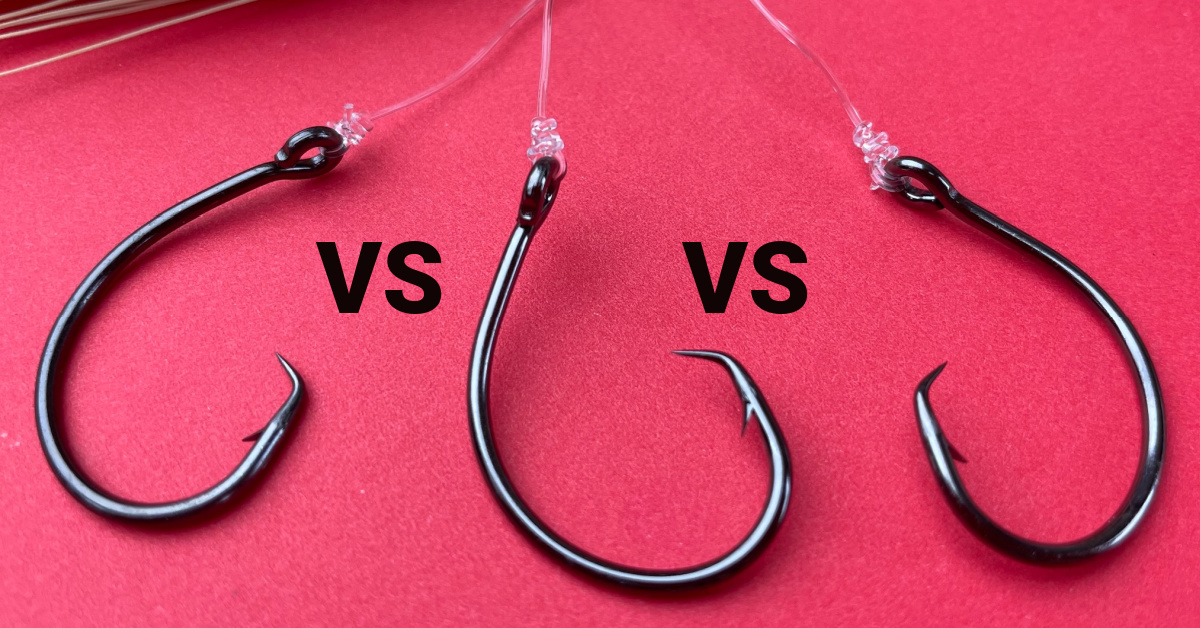
We have a new winner!
I did a new strength contest to find the ultimate knot for both mono and fluoro going to a hook or a swivel.
The last time we did this experiment, we tested the uni knot and the clinch knot.
But this time we’re testing the clinch knot, the modified clinch knot, and the trilene knot against each other.
See who the new winner is in this experiment below!
Clinch Knot Vs Trilene Knot [VIDEO]

 Click here to join the Insider Club
You asked for a test between these knots and it turns out there is a new winner in the battle!
Spoiler alert, the clinch knot did not win.
I also tested the difference between using saliva and not using saliva when cinching down the knots.
Here are the lines used for the contest:
And here are the full results of the experiment:
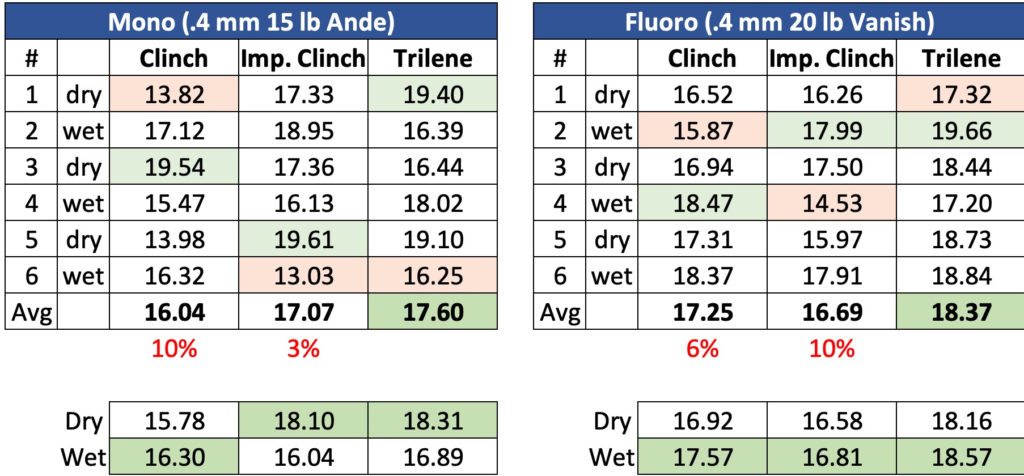
As you can see, the trilene knot won hands down!
If you want to see the results of the previous contest I did between the Clinch knot vs. Uni knot, click here.
Check out all of our fishing knot contests here.
Click here if you want to learn how to tie the clinch knot.
And click here if you want to learn how to tie the trilene knot.
Conclusion
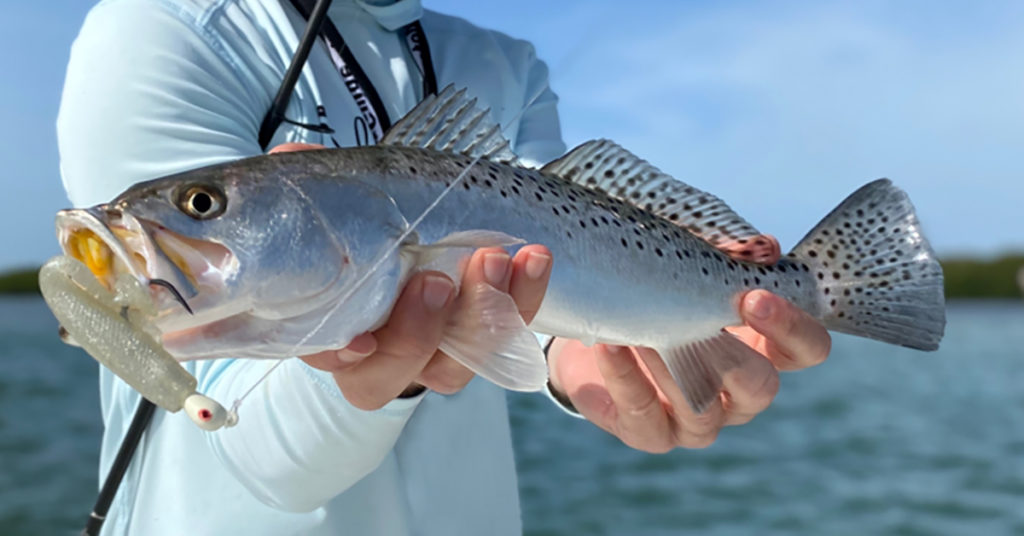
The clinch knot, the modified clinch knot, and the trilene knot are very similar.
But the small differences make a huge impact on the strength!
So if you’re tying mono or fluoro to a hook or swivel, I recommend using a trilene knot.
Do you use the trilene knot?
Want to see any other knot contests?
Let me know down in the comments!
And if you know someone who is looking for the strongest fishing knots, please TAG or SHARE this with them!
P.S. Want access to our best fishing spots and tips, plus discounts to our online tackle store? Click here to join us in the Insider Club!
Related articles:



Awhile back I conducted a whole series of measured knot tests for my own gratification (I’m a fishing enginerd). Two knots that arose to the top were the San Diego Jam terminal knot and the J-knot for bending two lines. If I remember correctly, this held true for both mono and flouro. I first tested lightweight tippets down to 7X. The San Diego Jam knot can be thought of as a reverse clinch knot with the tag end running thru one extra loop. And the J-knot has solidly proven itself to me. What I came away with is the ability to trout fish a whole tippet size smaller (= more trout strikes), but with a stronger and much more reliable rig (nary a break-off).
When learning to tie my own flouro saltwater fly leaders with some thick 30# and 40# sections, the J-knot again was a winner, sometimes beating out unknotted line. I use chapstick or shea butter to thoroughly grease the knot pull in larger diameters, and saliva for thin tippet. I have less experience with fly fishing heavy lines, am have more learning to do. When using the San Diego jam, I had better results in thick line by reducing the twists to five. A true 100% terminal knot in heavy flouro is the Tornado HH knot, although it is a big terminal knot. Look to flouro manufacturer Sunline for lots of flouro knot information.
What is still key is what knot you & I are practiced at tying well. Just because a knot is strong in the laboratory, doesn’t make it the most reliable knot in our hands.
My search continues for a winning loop knot in thicker flouro, like 1X (= 0.010”).
– Colorado Ralph
Thanks for sharing your findings Ralph! For the line to line connections, have you tried the Blood Knot yet? That beat out the double uni knot in my tests which means that it should beat the J-knot too (just make sure to give the thinner line more twists than the thicker one, and keep the twists in a consistent direction so that they sync up smoothly when they cinch down together).
I believe that I did compare the blood knot with some lower failures. That knot is a little more of a PIA to dress neatly. How about a cheater’s blood knot, meaning the tag ends both exit the same side to make tying easier?
It’s a big challenge for another bend knot to dethrone my J-knot at this point! And to break me from the Trouthunter addiction!
I’ll work the Rapala and Kreh loops knots into my 1X & 2X trout streamer fishing. The Rapala has the same appeal as the San Diego Jam by adding that extra tag line tuck.
Pure Nylon monofilament absorbs about 9.5% of it’s weight in water and undergoes physical property reduction. Methinks lots of monofilament brands are coated / treated / blended in response to this, however I’m paranoid and toss out old mono. We just cleaned out fishing grandma’s kit and some of that mono seemed to break all too easily.
Have you compared the Hurricane HH in flouro?
I have not yet tried the Hurricane lines. After countless experiments showing how fast fluoro breaks (compard to regular mono) when rubbed against a rough surface like a snook’s mouth, I have switched completely back to regular mono and am finding that it is helping me catch bigger fish with lighter lines.
Hurricane HH is a 100% strength, terminal chain knot. But a fatty!
Thanks. I’ll be sure to check that one out,
Trilene is the easiest to tie and the strongest so why use anything else hereafter in such an application? The numbers in the tables are the breaking point, correct? With mono or floro I have never needed more than 3 turns around the standing part of the line and often only two with no failures. Could you test that?
The sample sizes are way too small, relative to the variation, to mean anything. For the improved clinch versus trilene in mono, the 3% difference doesn’t come close to acheiving statistical significance, with a p-value of p=0.64 (would need to be smaller than 0.05 for significance). The differences you report could be easily due to chance variation, not consistent properties of the line. The 95% confidence interval for the difference berween trilene vs mono is -3.02 to 1.96, meaning there is essentially no evidence the trilene is superior to the improved clinch.
Thanks for making time to post the helpful feedback. I completely agree that this basic test will certainly not get to a 95% confidence level in situations like this when the results are relatively close between the Trilene and Improved Clinch. The key takeaway is that it’s clearly better to do more than just the basic Clinch knot because the small tweaks can result in positive strength differences.
Hey Luke great video. sorry if this question has already been asked but when using heavier lines say 40#, 60# and 80# how many wraps do you use for these knots?
I don’t use lines that heavy very often so I haven’t done tests on them. But I have heard that 4 to 5 wraps is all that’s needed.
ok
Btw – this is the best comparison out there – so thanks for the re-test – go the Trilene!
Question now is – can you improve the tying to reduce fumbling (something that appeals to me as a kayaker in cold water)
I’m keen to see what you make of this approach to twisting as shown on the following YouTube video for tying a Clinch (see link at the end)
It might just be the ultimate way to quickly tie the knot – where instead of twisting the tag you twist the hook or swivel end
The improvement I see is that instead of fumbling to wrap the tag end around the main line you instead use a finger on the other hand thru the Trilene loops to twirl the both tag and main line – its much faster and eliminates fumbling and potentially loosing the tag end. But is it stronger? It would make for an interesting comparison
Anyway – you have big fan from Australia
https://www.youtube.com/watch?v=8Q_Hg80whBc
Re the wet vs dry inclusion is really a myth breaker .. meaning advising there was no need to wet .. at least for mono but only with fluoro
With that advice re mono you are touching on the assumed wisdom and folklore that wetting knots when synching stops the friction that otherwise affects the strength of the line
So why no need for mono but only fluoro? Different composition perhaps? Flouro is stiffer and heats up more?
You left a niggling doubt in our minds at the 5 min mark when you said the need for wetting for the fluoro might be because it was old. You suggested wetting fluoro knots if they stick when synching but that it wasn’t necessary if it didn’t.
It would be nice to compare apples with apples i.e. new mono with new fluoro
And if you did, you would be exploring folklore of wetting in earnest. It might just turn out to be the greatest myth breaker in fishing .. or perhaps the greatest line breaker 🙂
I have included a similar check on wet vs. dry in multiple knot tests, and it seems as if there isn’t a definite one size fits all answer as it seems to depend on the knot used as well as the type of line.
cheers Luke
when you say you’ve included a similar check on wet vs. dry in multiple knot tests is that in the same YouTube https://www.youtube.com/watch?v=o9KubArXMEA&t=307s or another one?
George Anderson is well known in fly fishing circles for doing the annual “Yellowstone Shootout” to rate the best fly rods.
In 2012 he did a “Tippet Shootout” to determine the best brand of tippet and the best knots – it remains as the most definitive test of small diameter tippet and knots ties with tippet. He examined 30 brands of mono and fluoro and tied over 2,500 knots!
The San Diego Jam was the best tippet to hook knot and the J knot the best tippet to tippet knot.
But … manufacturers have improved their mono and fluoro since 2012, and as a trout fisherman, the largest tippet size tested was 2x.
I’d be interested in your testing the San Diego Jam and the J knot (just a triple surgeons knot, but reversing the direction of going through the loop with each pass).
The San Diego Jam knot did well, but the uni knot proved to be a bit strong in my testing… just barely though so it’s certainly a good knot.
I haven’t yet tried the J knot, but it’s surely good too because the surgeons knot is a great design.
Thanks for the info, can’t wait for the braid test!
The FG knot has become the go to knot for braid to nylon leader. I happen to prefer tying the Alberto with a twist. At the end of the knot I tie three overhand knots with the braid tag end. This seems to secure the braid from coming united. Have you tested this alteration?
Quick question, not sure if the video answered it, did all the lines break at the knot?
Almost all of the breaks (roughly 95% of them) occurred right at the top of the hook in which the knot flew off from the line and the hook. Only a few broke at the top of the knot in which the knot remained on the hook after the break.