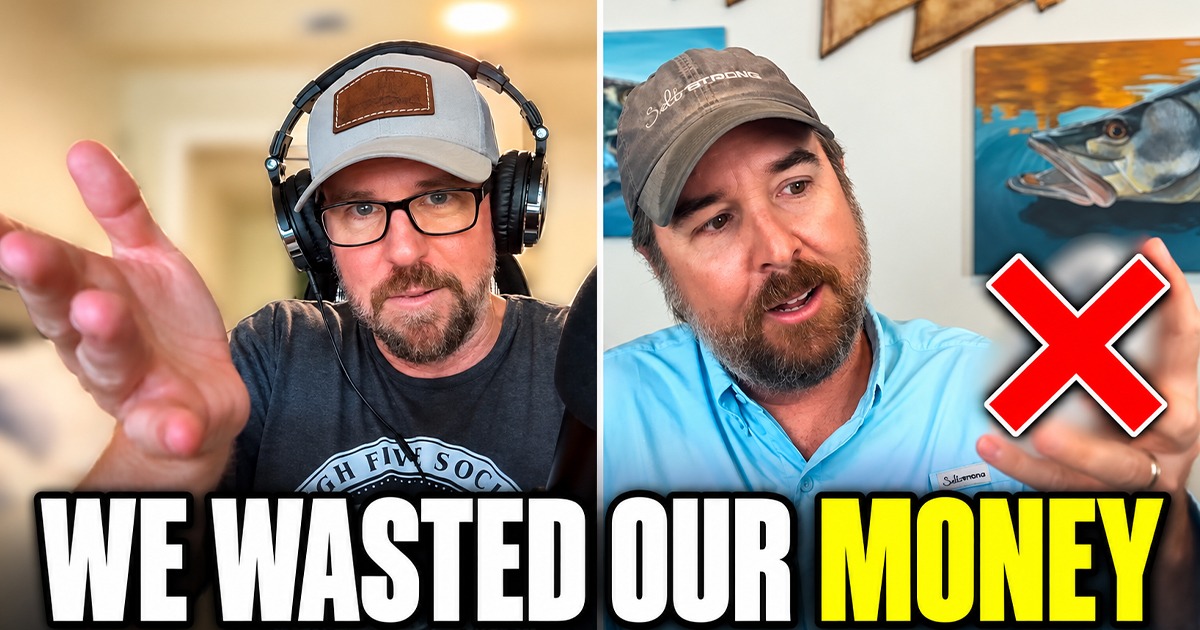
I spent $900 on a fishing reel… and I wish I could take it back.
And Luke’s biggest regret? Something we STILL SELL.
In this podcast, we’re sharing six tackle purchases we regret, so you know what to skip, what’s actually worth your money, and when the CHEAPER option is better.

Featured Gear
- Reel: Otis 2500
- Lure 1: Mulligan 5-Inch Bomber
- Lure 2: Prawn Original
- Rod: Slot Machine
I’ve owned a reel that cost around $900.
It’s incredibly smooth, lightweight, and fun to fish with. But I started worrying about it so much that I didn’t want to travel with it or let my kids use it.
That’s a lot of money tied up in something I’m sometimes afraid to enjoy.
Luke made a different version of the same mistake: spending most of his budget on the reel, then buying a rod with whatever was left.
For fishing with artificial lures, his priorities now are:
- Choose a rod suited to the fishing you’ll be doing.
- Pair it with quality line.
- Choose a reel that fits the rod and line.
The rod affects your casting, your ability to feel a bite, and your hookset. It deserves more attention than the leftover budget.
Luke now often spends at least twice as much on his rod as his reel. You don’t have to follow an exact ratio, but the point is worth remembering before you spend big on a reel.
That’s also why we wanted the Otis 2500 to deliver the performance we need at a price that lets us enjoy using it.
Buy Gear for the Fishing You Actually Do
Years ago, I bought an expensive setup for a beach tarpon trip.
I had one very specific situation in mind, went all in, and barely used that setup afterward.
Then I made a similar mistake buying a dedicated live bait combo for an outing. The guide had gear available, and I could have used an inshore setup I already owned anyway.
Before buying another rod and reel, ask yourself:
- How often will I actually use this?
- Can something I already own handle the job?
- Could I borrow the gear for this trip?
Some situations call for specialized equipment. But buying a whole new setup for a single outing can leave you with an expensive reminder sitting in the corner.
Be careful with combos that make the rod feel like a free bonus, too. A bargain loses its appeal when the rod doesn’t perform the way you need it to.
Buy for the fishing you regularly do, and make sure the rod is right for the job.
Choose Versatile Lures Before Fancy Colors
It’s easy to look at a realistic paint job and think, “That HAS to catch fish.”
Luke used to put a lot more value on those details. After years of testing, he cares much more about what a lure lets him do.
Can he rig it weedless? Fish it shallow? Put it on a jighead and reach deeper water?
That’s why he brought up the Prawn and Mulligan Bomber.
With different rigging options, he can use those profiles across a range of depths and conditions without carrying a tackle bag full of specialized lures.
Color can be part of the decision, but it shouldn’t distract you from getting your lure to the fish and presenting it effectively.
Being good with a few versatile lures is more useful than owning every color of a lure you barely know how to fish.
Focus on depth coverage, rigging, and learning how your lures work. A fancy paint job won’t do those things for you.
Make Your Leader Earn the Extra Cost
One of Luke’s biggest regrets was spending so much money on fluorocarbon leader.
He believed the claims about its advantages. In fact, he started testing it because he expected to prove how good it was.
His results changed his mind.
In the comparisons he describes in this episode, regular monofilament performed better in abrasion testing, and he didn’t see a strike advantage from fluorocarbon when matching line diameters.
That last detail matters: matching the pound-test rating isn’t necessarily the same as matching the diameter.
Luke now uses mono for his inshore leaders based on those results and his experience landing fish.
We sell both, but we’re going to share what we’ve found even when the less expensive option is the one we prefer.
Before paying more for a leader, make sure the benefit you’re buying shows up in the fishing you do.
Final Thoughts
I’m all for buying good fishing gear. I just want it to earn its place on the boat.
A rod that helps you fish better, a reel you enjoy using, and a few lures you know well can go a long way. The expensive setup collecting dust at home doesn’t help much.
Now I want to hear yours.
What’s a fishing purchase you regret, whether it didn’t work, wasn’t worth the money, or got used once and has been collecting dust ever since?
Let me know in the comments!
Frequently Asked Questions
Should I spend more on my rod or my reel?
For the lure fishing we discuss here, Luke prioritizes the rod first, quality line second, and the reel third. Choose a rod suited to your fishing, then match the rest of the setup to it.
Do I need a separate setup for live bait fishing?
Not always. For the inshore live bait trip I describe, a setup I already owned would have handled the job. Consider the bait, target fish, and conditions before buying another combo.
Does lure color matter more than depth?
Luke puts more emphasis on depth coverage and presentation than exact color or realistic paint details. Start with a lure you can rig to reach the fish and work effectively.
Which Mulligan lure does Luke mention?
Luke discusses the 5-inch Mulligan Bomber. He highlights its versatility, including the ability to rig it weedless or use it on a jighead.
Why does Luke prefer monofilament leader?
In the testing and fishing experiences he describes, mono gave him better abrasion resistance without a noticeable reduction in strikes at comparable diameters. Those results led him to switch his inshore leaders to mono.



I liked this video, I can think of $10,000 in stuff I bought for fishing that I used once or never used. I can’t tell you how many lures I bought at the bait shop near the boat launch. Go out and use an old tried and true, never getting the new lure wet. Line… I ran a charter… line was extremely important. I used Vanish one season. It was always breaking, I would get so irritated. I thought that maybe it was old line so I bought new only to have it breaking again. I noticed that it always felt frayed after it had a fish or two not so much new the lure and that’s because the lures we used. The fray was up the line 24 maybe 36 inches. It was the line contacting the bottom of the lake. Once I figured it out all the Vanish… vanished. I spent a lot of money on line. To think I filled the reels with Vanish.
The pole, line,then the reel. Thanks guys. 🤗🎣🙏💯
Great advice and I have been buyin the pole and matching it with a reel before the line. I always had a line preference that I use on all my fishing reels. The only regreat that I have is when I was in my teens, I got hooked on making my own fishing rods. But the problem was that I did not have a lot of money so I had to buy what I could afford. The selection of the blank is the most important item and I always choose the cheapest blanks. Now I have a few homemade rods that I can’t use.
Thanks for sharing your findings. Yes, it’s always tempting to save money on the blank since that’s the item that can save the most money.
My mistake was you had to go big in tackle and heavy line to get the big fish. All he forum’s when you start ocean fishing say 50lb and heavy rod and reel. You just don’t get snook or reds that way!
Great advice ,selling the correct combination rather than just focusing on the bottom line $
and actually testing to back up your recommendations Keep it up
Thanks for the advice. I have started working from the rod to the line and then a good comfortable reel. I have been doing better on putting fish in the boat and then the grease!!! 🎣🎣🎣 Tight Lines!!
Two disagreements. When fishing live bait, I often (not always) prefer my old rod with stainless steel guides. It’s strung with mono on an old Penn 104 Silver. It simply casts the bait further without ripping it off when I’m trying to cast out far. I’m only using circle hooks with it, so I don’t think the lack of braid is a big deal. It’s a soft tip (medium for sure) with a heavier backbone (medium-heavy) I would say. Other disagreement, I have two older Penn combos that I bought before knowing better. Although I would not do it again, the rods definitely are not garbage. Not what I prefer now, but not garbage. The Penn combos were always the only ones that made sense, or for some might still make sense. Yes, the rod blanks are a lower modulus, but way better than say an Ugly Stick. Beginners might feel that it makes sense as a starter and to later upgrade the rod. That’s what I did. I bought very inexpensive KastKing reels and matched them on the old rods. I have zero concern about putting those Franken-Combos in the hands of my grand-nephews and nieces. As far as regrets in gear — it would have to be the florocarbon leader material. I never bought much (I’m practical a/k/a cheap — LOL), and I kept looking for independent testing before I would fully commit but saw no independent “scientific” reviews until yours.
I have been with Saltstrong going on my second year. I retired about three years ago and started finishing with my neighbor on his nice flats boat. Knowing much about ensure solar fishing just been following his lead. It has been a lot of fun but his information I found out the last year and a half is not always been the best lol. It’s been good for him because I bought several of his old rods and reels. My regret now is that I know more now than I did then and I spent good money on junk equipment lol so since I am retired, I’m saving up to buy a nice rod and real from Saltstrong. I did purchase a brand new reel with them when I first signed up and it’s been working well. One thing I don’t regret is signing up for saltStrong. I don’t think I catch as much fish as I should be, but I’m getting better thanks for all the help from all the different groups.
Couldn’t one argue that because the diameter of fluoro is thinner that it’s an advantage over mono? A 20 lb fluoro is thinner than 20 lb mono.? Thanks Luke. I use mono because of your test!
Yes, but that argument gets crushed quickly when you test a 15 lb mono against a 20 lb fluoro… the mono proves to be stronger while being slightly thinner: https://www.saltstrong.com/articles/mono-vs-fluoro-knot-strength-test/
Good stuff Luke.
Great expose! I especially follow Luke’s recommendation on mono leader…go-to for me is 15# Ande! My biggest regret was a custom 12’6″ Lamiglas Hatteras Heaver drum rod matched with a tricked out Penn Mag525 reel. Used it once and never caught a drum or anything else. If Joe wants a rod to go with his Exist he can look into a custom Century. There is one for sale here on the Outer Banks for over $1700 plus tax. Granted it is a surf rod and a little big for his Exist. But a good Century trout rod with decent guides will get near to $800!