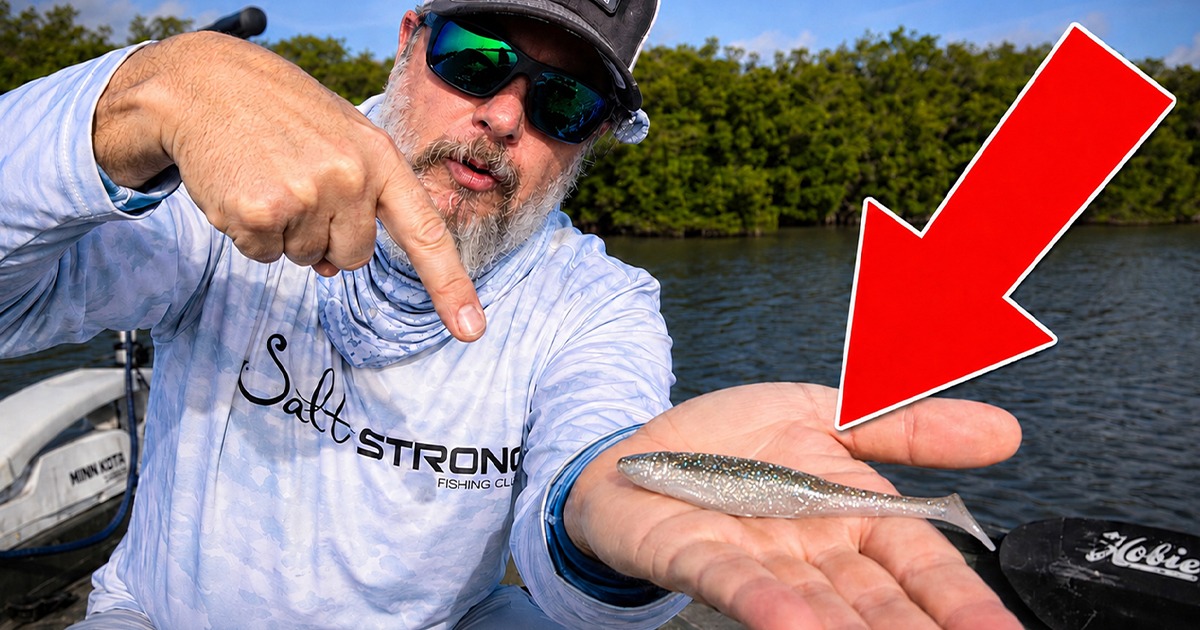
If you’re struggling to catch fish on paddletails, there’s a good chance you’re making the same mistake I made when I first started fishing artificials inshore.
For years, I thought success came down to lure color, jighead selection, or some secret retrieve.
It turns out the biggest mistake I was making was much simpler than that.
In this video, I’ll show you the one adjustment that dramatically improved my catch rates, plus another common mistake that keeps anglers from consistently catching fish on paddletails.

Free Rigging Guide Cheat Sheet
Depth control with soft plastic lures is extremely important, so we created a helpful single-page guide that shows you exactly which jighead to pair with the given lure for certain depth ranges.
Click here to see the Rigging Guide
Featured Gear:
- Lure: The 2.0 – Slam Shady
Why Am I Not Catching Fish On Paddletails?
The biggest mistake I see anglers make is fishing their lure too high in the water column.
That’s exactly what I was doing.
I’d cast out and immediately start reeling, which meant my lure never really spent much time in the strike zone.
What eventually changed everything for me was realizing that I needed to keep my lure near the bottom.
That’s where many redfish, trout, snook, and flounder are feeding.
And if your lure isn’t getting down there, you’re missing a lot of opportunities.
Should A Paddletail Be On The Bottom?
Most of the time, yes.
There are certainly situations where fish will eat a faster-moving lure higher in the water column, but if you’re looking for the most consistent way to catch fish on a Paddletail, I recommend keeping it near the bottom.
One of the easiest ways to do that is by simply allowing your lure to sink after the cast.
Instead of immediately engaging the reel and starting your retrieve, give the lure a second or two to fall.
Even in shallow water, that small adjustment can make a huge difference.
How Do You Know If Your Paddletail Is Reaching The Bottom?
This is one of the most common questions I get from newer anglers.
Fortunately, there are a few easy ways to tell.
Your lure is likely reaching the bottom if:
- Your rod tip occasionally deflects during the retrieve
- You feel the lure ticking grass, shell, or structure
- Your line settles when you stop reeling
- The lure slowly sinks when you pause your retrieve
If you’re ever unsure, stop reeling and let the lure fall again.
Once it reaches bottom, resume your retrieve.
It’s a simple trick, but it helps you stay in the strike zone much longer.
What’s The Best Paddletail Retrieve For Beginners?
One of the biggest misconceptions in fishing is that you need a complicated retrieve to catch fish.
You don’t.
In fact, if you’re just getting started with artificials, I recommend keeping things as simple as possible.
My advice is to use a slow, steady retrieve while maintaining bottom contact.
That’s it.
As your confidence grows, you can experiment with other retrieves and presentations, but this simple approach catches fish year-round and works in a wide variety of situations.
Where Should You Cast A Paddletail?
Another mistake I see all the time is anglers casting away from structure.
Fish are attracted to areas that are different from their surroundings.
Instead of blindly casting into open water, focus on areas like:
- Oyster bars
- Mangrove points
- Dock pilings
- Grass potholes
- Shell beds
- Shoreline points
Any area that creates an ambush point or provides a change in habitat can hold fish.
The more accurately you can present your lure around those areas, the better your chances of getting bit.
Final Thoughts
Looking back, I spent way too much time overcomplicating Paddletail fishing.
The biggest breakthrough came when I started focusing on keeping my lure near the bottom and fishing around structure.
If you’re struggling with paddletails, start there.
Those two simple adjustments can help you stay in the strike zone longer, put your lure around more fish, and ultimately catch more redfish, trout, snook, and flounder.
Have any questions? Let me know in the comments below.




I noticed quite often that when I use a slow retrieve the fish will follow, but not commit to hitting the lure. Any tips or tricks for this situation?
Usually when this happens it because something is off. The paddle tail did it’s job of getting the fishes attention but not enough to make it commit. Some times a simple cadence change in the retrieve could be in order. Throw a pause in or even a twitch, that can trigger the predatory instinct and make the fish bite. If i see that more than once I would do a change in the lure, either color or profile and typically I will go down in size. This is where I believe scent comes into play too. As that fish is following your lure it’s gathering intel to determine if your lure is food or not. Any negative scents will throw the fish off.
Always good to get refreshed on simple tactics, Thanks Pat
Yes Sir!
I will certainly try that! Thanks Pat!
Let us know how it goes!
Great tutoring video Pat
Thanks Paul!
Thanks Pat
You’re welcome Ted!
thanks
No Problem Ronald!
I’m going to give this a try. I have not had good luck with paddletails. My go-to lures have been prawns and jerk baits. Thanks Pat.
Try slowing it down a little and let us know how it works out for you!
Thanks, Pat. Will try it out on Thursday.
Best of luck!
In actuality Pat pretty much ALL lures with the obvious exception of topwaters should be retrieved just a few inches about the bottom your never going to catch a flounder if your not keeping your lure very close to the bottom although believe it or not I did catch one on a topwater but that was a very rare incident and it happened only because the bottom was very shallow about a foot and I was bringing the topwater plug over a drop-off when it hit but ALL my lures with the exception of topwaters and I guess subsurface plugs being used for suspended fish are all retrieved so they are only a couple inches off bottom and yes when I see structure im always casting into it but first around it so as not to spook the fish that might be there I had a girlfriend that I took fishing but she would never cast to any cover near structure for fear of loosing my lures but I told her to not worry about it she did manage to catch a few nice fish but not as much as she could of if she would of listened to my advice anyways Pat great advice and thanks for all you do😉👍
If you’re not getting hung up every now and then you’re not fishing close enough!
Let be the video advice Thanks Pat! Will put this out to practice.
Let us know how it works for you!