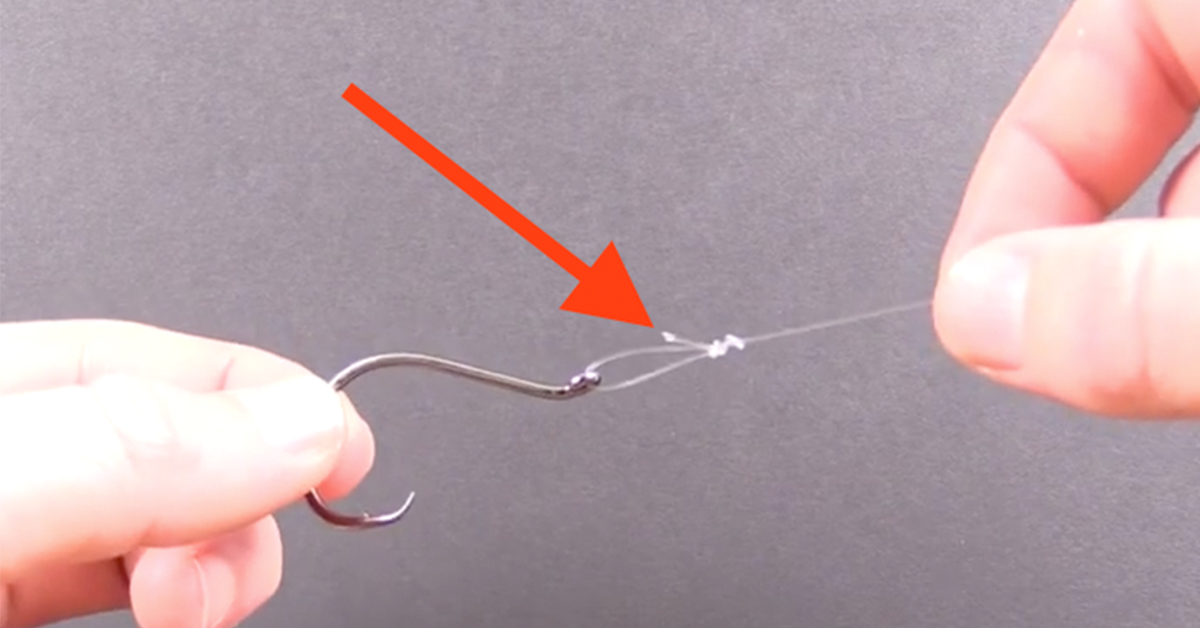
It’s Loop Knot Time!
Loop knots are extremely important to anglers who use artificial lures because they allow the baits to have the most action possible.
Since loop knots are an essential part of inshore fishing, we decided to host a “fishing knot contest” that put the top 4 most popular loop knots in a head-to-head battle so we could determine the best loop knot for fluorocarbon leader line.
Given that it can’t benefit from the 360-degree friction against the hook, the breaking strength of loop knots will be lower than most of the snug knot options. However, the added action that it provides to your lure makes it worthwhile… I highly recommend using this style whenever using artificial lures.
However, the added action that it provides to your lure makes it worthwhile… I highly recommend using this style whenever using artificial lures.
Here are the top snug knots that we tested in this fishing knot analysis:
- Kreh Loop Knot (aka: Non-Slip Loop Knot)
- Perfection Loop Knot
- Rapala Loop Knot
- Canoe Man Loop
Kreh Loop Knot (Non-Slip Loop Knot)
The ‘Kreh loop knot’ has been my knot of choice for the past 5 years once I found out about it. It’s easy to tie, has good strength, and its tag-end points down towards the lure allowing for it to be as weedless as possible.
See below for a video on how to tie it.

Note: Another name for this knot is the “Non-Slip Loop Knot”. The strength test results are shown below.
Perfection Loop Knot
I learned the ‘perfection loop knot’ years ago from a great flyfisherman (shout out to Dennis Aust) who is good friends with our family. It’s often used by fly fishermen for loop to loop connections, but it’s also very popular for tying on hooks and small lures to leader via a loop connection given its strength and ease of tying.
See video for details on how to tie the Perfection Loop Knot.
Note: Strength test results are shown below.
Rapala Loop Knot
The ‘Rapala loop knot’ is very similar to the Kreh loop knot, except that it has one added twist. The pro of this extra step is that it adds some strength to the knot. However, the downfall is that it leaves a weed-catching tag end that sticks straight up and is slightly more difficult to tie. Here’s a video that shows how to tie it:
However, the downfall is that it leaves a weed-catching tag end that sticks straight up and is slightly more difficult to tie.
Here’s a video that shows how to tie it:
Note: Strength test results are shown below.
Canoe Man Loop
The ‘Canoe Man Loop’ knot really impressed me when I first came across it… very easy to tie, strong, and the tag-end points down.
However, its strength when doing my initial tests with standard mono line did not translate over the fluorocarbon leader. Not sure why, but it scored lowest of the 4 consistently with fluoro while being one of the best with standard mono.
Here’s how to tie it in case you’re curious though:
Note: Strength test results are shown below.
CONCLUSION
Leader to Lure Loop Knot Winner
Although not quite the strongest in the category, my preference is staying with the Kreh Loop knot (aka. Non-Slip Loop knot) given that it’s easier to tie than the Rapala and that it’s tag end points directly down making it tough for those pesky weeds to ruin a presentation in front of a hungry fish.
For these line types, it’s breaking range matches exactly to the winner of the best braided line to fluorocarbon leader connection that we found in our line-to-line knot contest, so using the Kreh knot won’t cause any harm to the strength of the overall system.
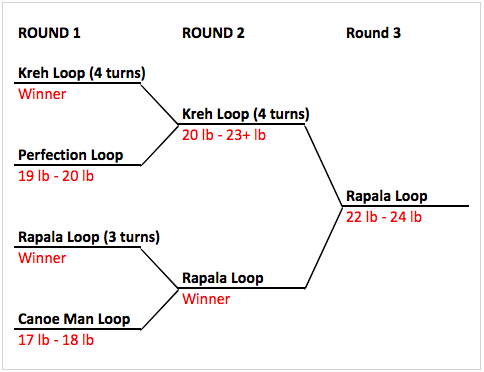
This diagram shows the head to head matches that took place as part of this analysis. The test consisted of 3 rounds where the 3rd round was the winning knot tied against itself to test its strength. The red values below the names of the knots represent the amount of pull strength that the knots were able to withstand in each round.
Note: Lines used were 10 lb PowerPro braid and 30 lb Ande Fluorocarbon.
This knot testing is continuous… we’re always seeking out better styles/methods, and we will, of course, update this page as new/better knots come to light.
If you have a great leader to hook/lure knot that is not included here, please leave a comment below or send us an email – fish@saltstrong.com
We’ll include it in our next knot testing and let you know how it compares to the others.
Go To Our Knot Testing Homepage [Full Knot Rankings]
Join The Fastest-Growing Fishing Community In America!
Here’s what you’ll receive today when you join:
- Daily fishing reports and TRENDS revealing exactly where you should fish ever trip
- 20% off all fishing tackle and gear (All major brands)
- Exclusive fishing tips from the PROS you can’t find anywhere else
- Private community of fellow saltwater anglers
- Everything you need to start catching fish more consistently (regardless if you fish out of a boat, kayak, or land).
Click here to join today.



In their book Practical Fishing Knots II by Mark Sosin and Lefty Kreh, the authors state that their instructions and ILLUSTRATIONS should be followed PRECISELY with regards to over, under, and direction of wrap.. Compared to the illustration in the book, Salt Strong seems to consistently wrap the tag end around the main line in the opposite direction relative to how the first overhand loop was formed. If you tie the knot in something large (550 cord is good), you will see that this makes a difference in the the final knot. The way Salt Strong ties it causes a piece of line to end up “between” the two legs of the loop, causing the loop to be more open. The Salt Strong tie also tends to put the tag end in a bit better position. What I do not know, and have not yet tested, is if there is a difference in strength between the two methods. I actually like the knot the Salt Strong tie makes, but it is different than the book and I do not know if it is as strong.
The strength difference between the direction of twists is surely going to be very small. For those of us who use stronger leaders than mainline, the loop knot is more about function (giving lure max freedom of motion) than strength.
Luke, thank you for the reply. I agree that it shouldn’t matter in a practical sense IF the leader is significantly stronger than the main line. While such is often true, it is not always true. And to be fair, the main point of the article WAS to test the loops against each other to determine the strongest one, NOT about function, which is the argument you are now making. (I absolutely agree the Kreh Loop has much to recommend it from easy to tie and function standpoints.) I am a bit surprised that you assume the difference due to direction of twist is very small. It wouldn’t surprise me if such were the case, but to assume so . . . After all, Salt Strong is careful about such things, which is why you test knots in both mono and fluorocarbon, along with different line strengths. You have found some surprises when you have done so, as with the Canoe Man Knot in fluorocarbon.
Good points. The reason why I went ahead and gave an assumption is because I have tested a lot of knot variables over the years, and almost all changes that slight have an inconsequential impact. That being said, I’ll make sure to try this out next time I get a chance.
Note: This contest was done about 9 years ago. Since then, I have been using this version of the non slip loop knot but with just 2 twists. It forms into a small/sleek knot and has plenty of power for my saltwater fishing needs while targeting all sizes of fish up to full grown tarpon down to spooky reds with very light line.
Luke, thank you for the reply. That is interesting because in the book I mentioned the authors are also very specific about the number of turns based on the line strength. But if the knot you are tying is working for you, that is really all that matters. Thank you for being willing to have a discussion!
Here’s a link to a knot contest I did to see how much of a difference it made to have 2, 3, or 4 twists: https://www.saltstrong.com/articles/twists-for-non-slip-loop-knot/
Although the 3 twists did win, I switched to the 2 twists since it’s a cleaner knot that’s still more than strong enough to never break when my drag is set properly.
For lines testing 8X to 6-pound-test, make seven turns; for 8- to 12-pound-test, make five turns; for 15- to 40-pound-test, four turns; and for line heavier than that, make only two turns. For thin, flexible modern multi strand plastic-coated braided wire lines, make three turns. For the older plastic-coated braided wire, two turns are enough
What does salt strong not teach us.yall are so complete and above and beyond and it is very much appreciated thank you mike justice
I like the Kreh knot the best and easiest to tie for my fingers and I like the end too be hid in the loop thanks for the suggestion Luke
Thanks, it’s time for me to switch over to this knot for inshore
@LukeSimonds – I’ve always loved the canoeman loop knot, but saw this post and see you guys seem to really like the non-slip loop knot. However, I did notice your comment about the canoeman loop knot performing very well with mono. I always use braid with a mono leader. How much of a difference is there between the canoeman and non-slip loop knots when using mono?
The difference was very small and it likely will differ based on the lines used. To see what works best for your line of choice, I recommend tying each end of short line. Then attach one end to a fixed object and pull until the weaker knot breaks.
Ok, so I tested my knot between rapala and kreh loop and perfection. On a 30lb fluoro I got a surprise. Kreh/non slip is stronger on all of my test. Perfection was way weaker I stop testing it after six knots. On a gamma Fluorocarbon 30# .50mm diameter. Rapala broke @26.6 on average. Kreh broke @ 32.8# average. On Yozuri Topknot fluorocarbon 30# .47mm diamter. Rapala broke @ 25.4# average and Kreh 29.3# average. Also found out Kreh/non slip are stronger than trilene knot on the hook. I am testing these knot to fish Tuna Offshore using live bait. I will ditched ringed hooks and will now use Kreh/non slip knot. PLine shinsei fluorocarbon are a bit stringer than gamma w same .53mm diameter. Rapala@27.05# and Kreh@35.6#.
After several test, My best combo are Suffix 832 50# FG knot to Pline Fluorocarbon (34# breaking strength) and non slip knot to mustad 39950 circle hook.
all knots are exactly the same as video above. Wet in water before pulling tight w a dowel.
Thanks for sharing your findings Ben! I’m very surprised to see that the non slip look knot beat the trilene knot.
How many wraps around the mainline do you make with your non slip loop knot?
I am afraid your Kreh Loop Knot explanantion is not only wrong, but poorly explained and shown. You put the tag end through the middle of the loop when it should be alongside the existing two lengths of nylon so that all three lengths of nylon are entering and exiting the loop on the same plane. Sorry to say this but Tightline Videos have a much better instruction.
It sounds as if you’re referring to the part after making the twists where the tag end is threaded back through the loop.
If so, our video shows the exact same tying method you described where all 3 lines are entering and exiting on the same plane… the tag end going through the middle of the loop was good because the other two lines were already there and that final move put them all together inside the loop right next to one another to complete a very good loop knot.
In our case, the method is to simply go up through the downward facing side when going up. And then to go through the upward facing side when on the way back down resulting in the lines all being on the same plane.
Luke, have you tested the surgeon’s loop as a fluorocarbon to lure or hook loop knot?
Yes, it’s a strong knot, but I prefer the non-slip loop knot because it’s easier to tie for lures and it leaves the tag end pointing back which decreases the odds of the knot snagging onto floating debris.
i see little difference in break strength between the kreh and the rapala but i do see big difference in the direction the tag end winds up pointing so i will go with the kreh
FYI, that loop shouldn’t be called the “Kreh knot.” It was not Lefty Kreh’s. He said he liked it and used it, but didn’t invent it. Not sure he knew who did.
Another name for it is the “Non-Slip Loop knot”