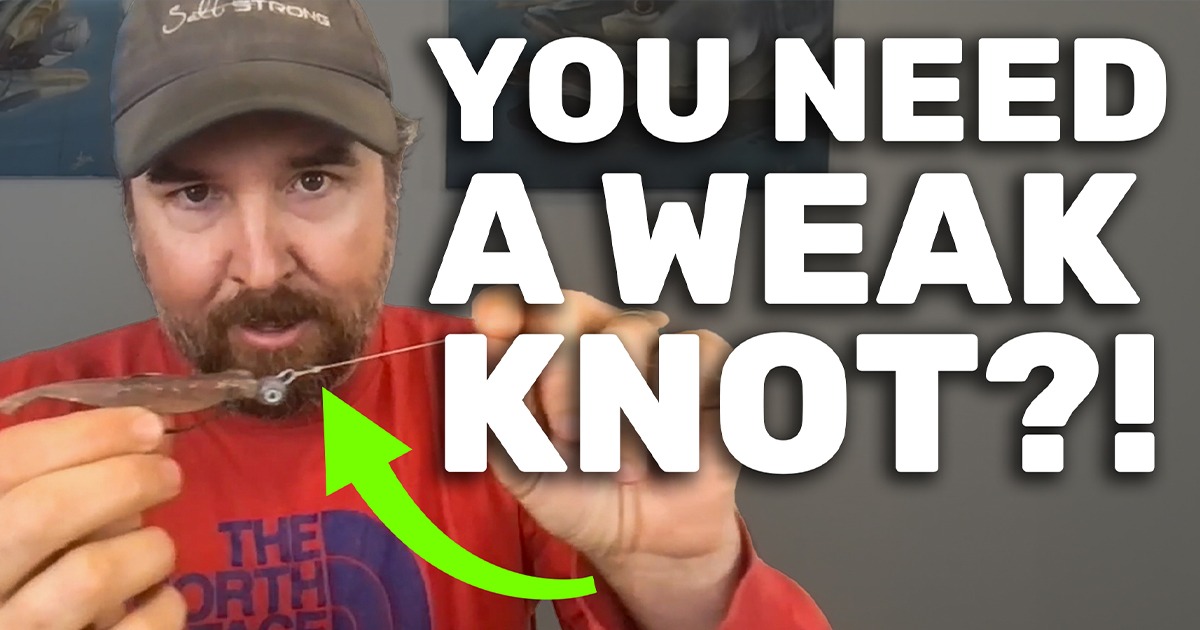
We’ve been conducting knot and line tests for over a decade to make sure that we never lose a fish of a lifetime due to a bad knot.
There aren’t many things other than our knots that we have 100% control over, so it’s our duty to make sure to put time into learning the best knots for each connection.
This video will explain why the best knot for each connection isn’t always the strongest knot.
And you’ll also see a distinction between a weak knot and a bad knot.
Key Takeaways
- The strongest knot for each connection isn’t always the best one
- Where your line assembly fails during a tension break matters
- A weak knot can be the best knot in some cases
- One easy adjustment can help you avoid wasting valuable time trying new rigs while on the water
If you fish hard structure zones like rocks, docks, mangroves, oysters, etc, then you’re going to enjoy this discussion.

Featured Gear:
Typical Inshore Setup
- Rod: Slot Machine Medium
- Reel: Otis 2500
- Line: 10 lb Daiwa J-Braid
- Leader: 20 lb mono with 30 lb bite tippet
- Knots (from rod to lure): FG, Blood, 2-Turn Non-Slip Loop
- Example Trip: 90-Inch Slam With Lures While Exploring New Waters
Note: This is for snook territory… go down a level for the leader lines if you won’t be hooking snook.
Reef Setup
- Rod: Slot Machibe Medium Heavy
- Reel: Otis 2500
- Line: 20 lb Daiwa J-Braid
- Leader: 30 lb mono with a 40 lb bite tippet
- Knots (from rod to lure): FG, Blood, 2-Turn Non-Slip Loop
- Example Trip: Pink vs. Natural Color Experiment [Monster Snook & Redfish]
Note: This is for snook territory… go down a level for the leader lines if you won’t be hooking snook.
Ultra-Light Setup
- Rod: Slot Machine Medium
- Reel: Fuego 1000
- Line: 6 lb Daiwa J-Braid
- Leader: 12 lb Mono with 20 lb bite tippet
- Knots (from rod to lure): FG, Blood, 2-Turn Non-Slip Loop
- Example Trip: Sight Fishing Upper/Overslot Reds In Calm Clear Water
Note: This is for snook territory… go down a level for the leader lines if you won’t be hooking snook.
Final Thoughts
This isn’t about tying bad knots.
It’s about deciding where your system should break before the fish decide for you.
If you’re fishing tight to structure to maximize your catch results, you are going to be at risk of losing rigs to the bottom even if you’re using weedless lures.
So the smart play is to make sure you are strategic in your knot tying so that you maximize the strength of knots on the most fragile line connections while making sure to use knots on the stronger lines to make sure that the final connection is slightly weaker than the others so you get your leader assembly back.
The best bites often happen in short windows, so this line strategy will help you maximize your valuable time out on the water fishing… not rigging.
IMPORTANT REMINDER
The 2 core benefits we promise to Insider Club members is to be able to find and catch fish easier than ever before while saving money on fishing equipment.
So I am including links to the quickest ways to achieve each:



very good info on rigging your rod. Need to put it to the test>
I guess its just me because I don’t really worry about science in fishing whether it is about knots or line size or whatever and being extremely old fashioned I just stick with what has worked for me for decades now the 3 main knots I use and tie have seldom failed me but one needs to know that because NOTHING in this world is perfect then obviously there are no gaurentees either all I know is what I use works and I catch plenty of fish with what I have and use but on the flip side I understand why you do all these experiments and tests because you own and manage a fishing club so your always trying to give members the best possible info that there money can buy which is totally fine and in actuality its what a good club should do for there members anyways good intel as usual and thanks for all you do😉👍
Saltwater fly fisherman have been using this strategy to protect their expensive fly lines. For effective, casting, fly leaders taper down to what is called the tippet, which is the lightest and weakest part of the whole set up. Then they tie a short, maybe 1 foot, section of what is called a bite tippet onto the leader, typically with a blood knot. As with spin fishing, the bite tippet is more resistant to structure and sharp teeth. The fly is then tied to the bite tippet, usually with a nonslip loop knot. The hope is that if the system breaks, it will be at the blood knot, thereby protecting both the leader and the fly line.
I guess there’s different take aways. I took away Luke saying to tie a weak knot at the lure so it breaks there rather than at the blood knot if using a tippet. Count me skeptical in the sense of to much finesse, especially in a club with many beginners who are not expert knot tiers like Luke. The idea that you can confidently tie a 21# breaking strength knot at the lure end of a 30# tippet is suspect. Remember how much dispersion in those recent knot tests between the same knot tied with the same braid and leader that were done by Luke. And Luke acknowledged how carefully he tried to tie and cinch them so it’s challenging for even an expert knot tier to achieve nearly identical breaking strength each time he/she ties a knot. Concerning structure, often it’s not just about a lure getting hung up (and often in the mouth of the fish) but the leader/line getting compromised or wrapped. Maybe there’s an argument for less breakoffs but they’re going to occur when fishing structure, especially offshore reef fishing.
The core message of the this post was simply to raise awareness for thinking about exactly where the weak point is in the line assembly.
As for the bite tippets, they serve multiple benefits. The main one is to be able to get more strikes while having beefed up ending that can handle abrasive fish like snook. Another benefit is that they can serve as a guaranty that the FG knot will not be the weak point… if the loop knot doesn’t fail, then the blood knot connecting the weaker leader to the bite tippet will be the one to go.
Where do you go to give a name to the new black tweaker?
This was the original post for the name contest for the new black/silver color: https://community.saltstrong.com/post/184769
Great information , not very familiar with the blood knot !! Will definitely look into that .. thanks
Thanks Roy. Glad to see that you enjoyed this discussion.
What about the surgeon not
That is a great knot too. It’s perhaps slightly stronger than the blood knot (if making 3+ turns), but it’s much more bulky and has tags poking out from the top and bottom of it, so I do not recommend it for connecting to a bite tippet.
Being new to inshore saltwater fishing with braid mainline, these leader and knot recommendations are fantastic Luke. Thanks for laying out the system for optimizing rigging so clearly.
Our pleasure James!
Very Interesting. Thank you.
Holy Handgrenade!!!
Good reminder Luke- You taught me this about 4 yrs ago! 2 wraps on the loop knot with a side of FG knot and good to go!